
![[IPWatchdog Logo]](https://ipwatchdog.com/wp-content/themes/IPWatchdog%20-%202023/assets/images/temp/logo-small@2x.png)

 0
0 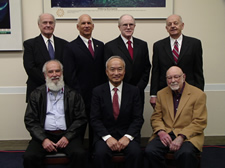 In celebration of the 50th anniversary of the integrated circuit, USPTO Director John Doll joined members of Congress and officials of the National Inventors Hall of Fame last week to announce the 2009 class of inductees. All those recognized are inventors of advances related to or enabled by integrated circuit technology. The 2009 inductees includes inventors such as Jean Hoerni, who developed the manufacturing process for modern integrated circuits; Alfred Cho, who achieved a process used in creating devices such as the lasers used in CD and DVD players and drives; and George Heilmeier, who pioneered the first liquid crystal displays.
Ten living inventors and five deceased innovators will be inducted at a ceremony at the Computer Museum in Mountain View, California on May 2, 2009.
This year’s inductees are:
Martin M. (John) Atalla (1924- ) MOS transistor Atalla was a Bell Labs inventor who worked with Dawon Kahng to invent the first practical field-effect transistor, the most widely employed type of integrated circuit. He went on to develop the data security system used in most automated banking machines, and as part of this system devised the PIN method of secure identification.
Alfred Y. Cho (1937- ) Molecular beam epitaxy-MBE Cho achieved molecular beam epitaxy (MBE) at Bell Labs, a process in which materials are layered atop one another with great precision to form devices like transistors, light-emitting diodes, and lasers. The switches in cell phones that carry our conversations are made using MBE, as are most of the lasers used in CD/DVD players and drives.
Ross Freeman (1948-1989) Field programmable gate array-FPGA Freeman, co-founder of Xilinx, invented the field programmable gate array (FPGA), a computer chip that can be programmed again and again, changing the way that it functions. FPGAs are useful in rapidly changing industries, like local area networking and cell phone networks.
Dov Frohman-Bentchkowsky (1939- ) EPROM Frohman-Bentchkowsky of Intel and founder of Intel Israel created the electrically programmable read-only memory chip, or EPROM, which could be erased by exposing it to ultraviolet light, then have new data written onto it. Today’s electronic devices like cell phones, digital cameras, MP3 players, and computers all rely on a form of this memory to store their operating systems.
George Heilmeier (1936- ) Liquid crystal display Heilmeier pioneered the first liquid crystal displays at RCA Laboratories. He went on from RCA to a diverse career, spending time as a White House Fellow, Special Assistant to the Secretary of Defense, and Director of the Defense Advanced Research Projects Agency (DARPA). He was also Chief Technical Officer for Texas Instruments.
Jean Hoerni (1924-1997) Planar process A co-founder of Fairchild Semiconductor and one of the Fairchild Eight, Hoerni invented the planar manufacturing process, the process that is relied upon for the manufacture of today’s modern integrated circuits. A consultant to semiconductor firms around the world, Hoerni founded Teledyne’s Almeco division, Intersil, and Telmos.
Larry Hornbeck (1943- ) Digital micromirror device-DMD Hornbeck, of Texas Instruments, holds a series of patents that form the foundation for the DMD, an array of up to two-million hinged microscopic aluminum mirrors on a silicon chip. Under digital control, the tiny mirrors create an image by directing pulses of “digital” light through a projection lens and onto a television, presentation, or movie theater screen.
Dawon Kahng (1931-1992) MOS transistor Kahng was an inventor, with John Atalla, of the first practical field-effect transistor, a device that controls electronic signals by switching them on or off or amplifying them. Today, the MOSFET is the most widely used type of integrated circuit in the computer and electronics industries. After time at Bell Labs, he founded the NEC Research Institute, which conducts basic science research in computing and communications.
John Macdougall (1940- ), Ken Manchester (1925- ) Ion implantation Macdougall and Manchester worked together at Sprague Electronics to develop a commercially viable method of ion implantation, a process in which a silicon wafer is bombarded with ionized atoms to change the electrical conductivity of certain areas, called “doping.” Ion implantation is the dominant doping method in the production of integrated circuits.
Carver Mead (1934- ) VLSI method for designing chips Mead, professor emeritus at Caltech, is an inventor, chip designer, entrepreneur, and physicist. He helped to develop the standards and tools that permitted tens of thousands of transistors to be packaged on a single silicon chip, known as very large-scale integration (VLSI). He has founded over 20 companies, including Synaptics and Impinj.
Gordon Moore (1929- ) Semiconductor production As a cofounder of both Fairchild Semiconductor and Intel, Moore set the pace and standards for Silicon Valley’s chip manufacturing methods. He is the author of Moore’s Law, and his work would establish the model of the computer industry researcher-entrepreneur and help make Intel a world-leading chip maker. He is chairman emeritus of Intel and founder of the Gordon and Betty Moore Foundation.
Gordon Teal (1907-2003) Silicon transistor Gordon Teal created the first functioning silicon transistor. By the time he announced his working silicon transistors at a 1954 meeting, his employer Texas Instruments had already begun production, skyrocketing the silicon semiconductor industry to success. Teal served briefly as the first director of the National Bureau of Standards materials research division.
Frank Wanlass (1933- ) Complementary metal oxide semiconductor-CMOS Wanlass invented the complementary metal oxide semiconductor (CMOS), the technology employed in most modern microchips. Because of their low power requirements, CMOS chips are well suited to battery-powered devices: the digital watch was one of the first products to make use of CMOS technology. Wanlass spent time at Fairchild Semiconductor, and was also involved in several start-up ventures including Zytrex and Standard Microsystems.
Robert Widlar (1937-1991) Linear integrated circuits Widlar designed the first commercially successful analog integrated circuit. These circuits are used to process and amplify signals like sound and radio waves, and they are used in the automotive industry and in communications and consumer electronics devices. Widlar saw success at National Semiconductor and was also a cofounder of Linear Technology Corporation.
An exhibit honoring the inductees is currently on display in the atrium of the Madison Building on the USPTO campus in Alexandria, Virginia.
![[Advertisement]](https://ipwatchdog.com/wp-content/uploads/2024/04/UnitedLex-May-2-2024-sidebar-700x500-1.jpg)
![[Advertisement]](https://ipwatchdog.com/wp-content/uploads/2024/04/Artificial-Intelligence-2024-REPLAY-sidebar-700x500-corrected.jpg)
![[Advertisement]](https://ipwatchdog.com/wp-content/uploads/2024/04/Patent-Litigation-Masters-2024-sidebar-700x500-1.jpg)

![[Advertisement]](https://ipwatchdog.com/wp-content/uploads/2021/12/WEBINAR-336-x-280-px.png)
![[Advertisement]](https://ipwatchdog.com/wp-content/uploads/2021/12/2021-Patent-Practice-on-Demand-recorded-Feb-2021-336-x-280.jpg)
![[Advertisement]](https://ipwatchdog.com/wp-content/uploads/2021/12/Ad-4-The-Invent-Patent-System™.png)






Join the Discussion
No comments yet.