
![[IPWatchdog Logo]](https://ipwatchdog.com/wp-content/themes/IPWatchdog%20-%202023/assets/images/temp/logo-small@2x.png)
Posts in Interviews & Conversations
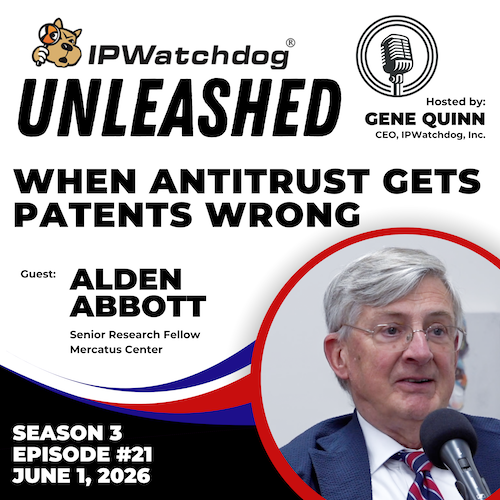
Efficient Infringement Rewards Copycats and Erodes Competition | IPWatchdog Unleashed
For much of the last four decades, American innovation policy has rested on a premise that should be obvious but too often is not: strong intellectual property rights are not an obstacle to competition. Quite the opposite—strong IP rights are the precursor to robust competition. The alternative to a robust patent system is not some frictionless utopia of open competition. The alternative is secrecy, copying, and underinvestment. If patents are too weak, companies will rely more heavily on trade secrets. That means less disclosure, less technical diffusion, and fewer opportunities for others to build upon what has been invented. Weak patents do not democratize innovation—they often bury it. Weak patents also reward copycats who find it far more expedient and financially rewarding to take rather than to innovate themselves. These truths were the main point at the center of my recent conversation with Alden Abbott, Senior Research Fellow at the Mercatus Center at George Mason University and former General Counsel of the Federal Trade Commission.
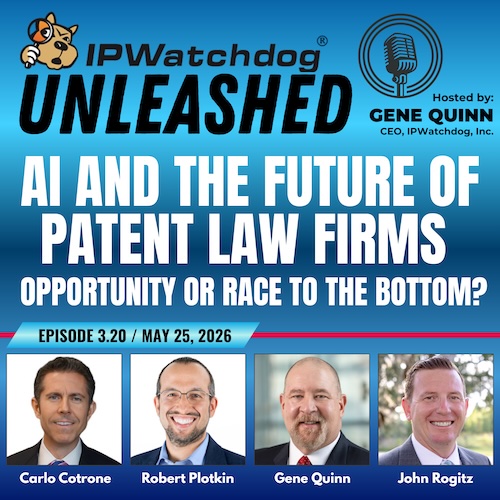
Patent Law Firms Face an AI Reckoning: The New Economics of Patent Practice | IPWatchdog Unleashed
While AI can improve research, drafting, analysis, and overall work product quality, the panel emphasized that it is not a magic button and cannot replace expert legal judgment. The most effective use of AI in patent practice is incremental, targeted, and lawyer-directed—more co-pilot than autopilot. Panelists explored the risks created when inventors, clients, or law firms over-rely on AI-generated disclosures, patent application critiques, or claim strategy recommendations, including the potential for increased attorney workload, inventorship complications, technical inaccuracies, and downstream litigation vulnerabilities. The conversation ultimately framed AI as both a market disruptor and a strategic opportunity for patent law firms. Firms that respond defensively or compete solely on price risk being pushed into an unsustainable race to the bottom. Firms that lean into client education, workflow redesign, transparent billing expectations, disciplined AI usage, and higher-value counseling will be better positioned to compete. The panel made clear that AI will not eliminate the need for sophisticated patent counsel; it will expose which firms are genuinely strategic partners and which are merely labor providers.
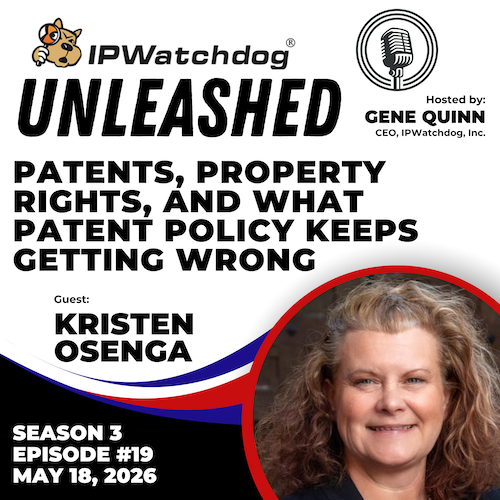
Patents, Property Rights, and What Patent Policy Keeps Getting Wrong | IPWatchdog Unleashed
This week on IPWatchdog Unleashed, I spoke with Kristen Osenga, who is a Professor of Law and Associate Dean for Academic Affairs at the University of Richmond School of Law. Kristen is a familiar voice to many in the patent community. She has been a regular participant in serious conversations about patent law, standard essential patents (SEPs), antitrust, competition policy, injunctions, and the broader innovation ecosystem.
IP Litigation Strategy: The Art of Winning Before Trial
At IPWatchdog LIVE 2026, a panel on IP litigation strategy returned to a point experienced litigators know well: most IP cases are not won at trial. Instead, the decisive work often occurs much earlier, through pre-suit diligence, early motion practice, discovery strategy, and expert challenges that shape whether a case survives long enough to reach a jury.
IPWatchdog LIVE Day Three: Coke Stewart Says Reexam Surge is on Office Radar; Rep. Kiley Talks Innovation Education on the Hill; and Meet the 2026 IPWatchdog Masters Hall of Fame Inductees
In the final session of IPWatchdog LIVE 2026 on Tuesday, March 24, U.S. Patent and Trademark Office (USPTO) Deputy Director Coke Morgan Stewart had a conversation with IPWatchdog Founder and CEO Gene Quinn in which she confirmed the Office is paying attention to the recent surge in ex parte reexamination filings and also said she is “optimistic” that the pending Notice of Proposed Rulemaking (NPRM) will be finalized.
Pioneering AI Innovations and Legacy: A Conversation with Inventor Gil Hyatt / IPWatchdog Unleashed
This week on IPWatchdog Unleashed, I sat down with prolific inventor Gil Hyatt, exploring his innovative journey and aspirations to leave a lasting legacy. One of the key highlights of the conversation was Gil’s creation of a non-profit Pioneering AI Foundation, which is aimed at advancing AI technology and bolstering U.S. economic interests. This non-profit organization is set to hold Gil’s substantial portfolio of AI patent applications, which cover his pioneering work dating back to the 1980s, and includes groundbreaking claims in artificial intelligence that could revolutionize sectors like education, manufacturing, and trade.
Entrepreneurship, Innovation and Becoming a Patented Inventor: Behind the Scenes with Renee Quinn
This week on IPWatchdog Unleashed, I sat down with my business and life partner, Renee Quinn. In addition to telling Renee’s story about how she found her way into the intellectual property world, and through our sometimes-comical banter, we together explore what it really takes to build, sustain, and continuously reinvent an entrepreneurial company like IPWatchdog. What emerged was a practical roadmap for entrepreneurship, invention, navigating platform risk, and focused on the necessity of constantly being ready to pivot as old business models start to show signs of age and ultimately falter. From Renee’s journey from IP outsider to patented inventor, to firsthand lessons learned navigating Amazon’s reseller ecosystem, the discussion highlights how intellectual property operates in the real world, not the classroom.
Looking Forward to 2026: IP Predictions and Prospects for the Year Ahead
On day one of 2026, we asked IP stakeholders to give their predictions for the year ahead on the IP front. From copyright and fair use to patent reform and USPTO operations, here is what they had to say about what to expect in the New Year.
What Do We Want? IP Stakeholders Weigh in on Wildest Dreams for 2026
While being realistic and practical in IP law is usually prudent, it’s a helpful exercise to now and then articulate one’s fantasies for a perfect world in order to gauge what topics come up most often. This year, as in years past, clarity on patent eligibility law remains high, while protections for an improvement of AI tools takes second. Some of the wishes below have little chance of coming true in 2026, but others may be granted—here is what our participants would like to see happen for IP in the new year.
Patent Reset: 2025’s Pivotal Moments and What Comes Next
As we wind down 2025 it is time to reflect on the year that was, and what the future will bring. This year was punctuated by a structural reset for the U.S. patent system. What unfolded was not just incremental reform, but a coordinated shift driven by leadership change, policy realignment, economic pressure, and accelerating adoption of AI—all converging to reshape how patents are examined, challenged, monetized, and managed. This week on IPWatchdog Unleashed we explore the monumental changes and the biggest trends that impacted the patent and innovation industry during 2025, and which will play an important role in defining 2026.
101 Crossroads: Can the USPTO Fix What the Courts and Congress Won’t? / IPWatchdog Unleashed
This week on IPWatchdog Unleashed, I have a conversation about patent eligibility with patent attorneys and IPWatchdog Advisory Committee members John Rogitz and Clint Mehall. There can be little doubt that the U.S. patent system is at an inflection point. The growth of artificial intelligence (AI) is accelerating, and there is a growing understanding that dominating AI technologies is a matter of national and economic security. But as important as everyone seems to recognize AI innovation to be, there is widely diverging handling of AI innovations within government, with almost astonishingly different views between the Executive Branch and the Judicial Branch, with the Legislative Branch simply missing in action.
The Slow Death of AIA Trials: A Look into the USPTO’s ‘One-and-Done’ Rule Package
There’s a lot going on at the Patent Trial and Appeal Board (PTAB) right now, and it’s not just the usual noise about discretionary denial. The United States Patent and Trademark Office (USPTO) has published a one-and-done rules package that, if it survives, would fundamentally change how inter partes review (IPR) challenge works, who can challenge patents, and when. The comment window on the proposed one-and-done rule has now closed. With more than 10,000 comments received by the USPTO and over 700 individual commenters weighing in, the proposed rules package has become a flashpoint for questions that go way beyond discretionary denial and AIA trials, with many asking whether the USPTO is functionally trying to engage in de facto legislation to neuter the PTAB.
Navigating the Changing Patent Landscape with Gene Quinn and John White | IPWatchdog Unleashed
This week on IPWatchdog Unleashed, I was joined by my longtime friend John White, who is the the creator of the patent bar review course I’ve taught for almost 27 years. Together we explore the intricate and ever changing patent landscape. First, we begin by discussing the bar exam and how it is changing, then we pivot to the evolving role of AI in patent law more generally. Our conversation traversed decades of personal history, friendship and professional insights, revealing how the industry has transformed over the years and what it means for the current and future generation of patent practitioners.
AI, IP and Data Risk: Responsibly Adopting AI While Safeguarding IP | IPWatchdog Unleashed
This week on IPWatchdog Unleashed, we feature a panel discussion that took place on October 27 as a part of our annual life sciences program. Initially styled as a conversation about how artificial intelligence is transforming life sciences, it became quickly apparent that the conversation was not going to be limited to the life sciences sector. Instead the discussion evolved into a robust discussion about data risk and intellectual property, focusing on what every innovative company should have front of mind when considering the adoption of AI tools.
IP and the Wild West Landscape of AI | IPWatchdog Unleashed
This week on IPWatchdog Unleashed I speak with Allison Gaul who serves as legal counsel for Boston Consulting Group. We begin our conversation with me asking about what she believes are the biggest legal issues in the IP world today. Gaul did identify several things that stay top of mind for her, with various issues relating to data front and center as the top issue. The second area identified by Gaul was open source, and how many of the AI companies promoting “open source” are really not truly open source because often the model, weights and/or training data are not made available, which makes it seem like these companies are racing to gain market share and ultimately “doing a little bit of a switcheroo.” The third and final thing that Gaul identifies as being constantly top of mind is the overall speed of AI development.
Varsity Sponsors
![[Advertisement]](https://ipwatchdog.com/wp-content/uploads/2026/05/Patent-Masters-2026-sidebar-700x500-rev1.jpg)
![[Advertisement]](https://ipwatchdog.com/wp-content/uploads/2026/05/Protege-in-PatentSight-product-350x250-Ad-A.png)
![[Advertisement]](https://ipwatchdog.com/wp-content/uploads/2026/05/LexisNexis-Jun-11-2026-sidebar-700x500-1.jpg)

Latest IPW Posts
Patents Don’t Monetize Themselves: Turning Portfolios from Cost Centers into Revenue Assets
June 8, 2026 @ 01:32 pmAutomating the Patent Process at the USPTO to Save Inventors Money
June 8, 2026 @ 11:15 amReaders React: What to Expect After the Supreme Court’s Hikma Ruling
June 7, 2026 @ 12:15 pm
Latest Podcasts

IPWatchdog Events
Webinar: How AI Is Transforming IP Strategy Across the Patent Lifecycle
June 11 @ 12:00 pm - 1:00 pm EDTWebinar: AI in Patent Drafting – When to Use Generative AI – and When Not To
June 25 @ 12:00 pm - 1:00 pm EDTFrom IPWatchdog
![[Advertisement]](https://ipwatchdog.com/wp-content/uploads/2021/12/WEBINAR-336-x-280-px.png)
![[Advertisement]](https://ipwatchdog.com/wp-content/uploads/2021/12/Ad-4-The-Invent-Patent-System™.png)