![[IPWatchdog Logo]](https://ipwatchdog.com/wp-content/themes/IPWatchdog%20-%202023/assets/images/temp/logo-small@2x.png)
Posts in Trademark
EUIPO-EPO Joint Report Finds IP-Driven Industries Contribute Nearly Half of EU GDP, One-Third of Total Jobs
On Thursday, the European Union Intellectual Property Office (EUIPO) and the European Patent Office (EPO) issued a joint report on IP and innovation in various industrial sectors of the European economy. Identifying IP-driven industries by analyzing registrations for IP rights within the EU, the agencies conclude that such industries contribute nearly half of the entire European gross domestic product (GDP) while also providing a third of the EU’s jobs, which offer workers larger wages on average when compared to total EU employment.
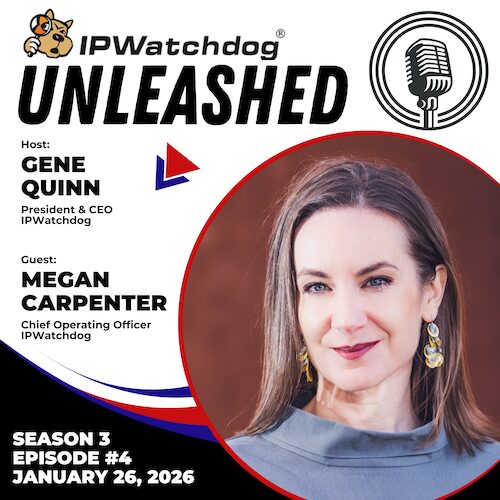
Strengthening IP Enables Human Creativity and Economic Mobility | IPWatchdog Unleashed
In this week’s episode of IPWatchdog Unleashed, I speak with Megan Carpenter, who just recently stepped down as Dean of UNH Franklin Pierce School of Law after more than eight years. Our conversation was part personal journey and business philosophy together with a candid assessment of the IP ecosystem. We tackle emerging issues, including AI’s impact on legal practice and education. And we discuss the role of IP as essential to sustaining innovation in a rapidly evolving global economy, and fostering human creativity, innovation, and economic mobility.
EUIPO-OECD Joint Study Details Close Link Between Global Counterfeit Trade and Abusive Labor Practices
Yesterday, the European Union Intellectual Property Office (EUIPO) and the Organisation for Economic Co-operation and Development (OECD) published the results of a joint study detailing the close connection between illicit trade in counterfeits and labor exploitation. The joint study shows clear, repeated associations between the intensity of counterfeit trade and abusive labor conditions, strongly suggesting that such conditions structurally enable the production and distribution of counterfeits.
CAFC Says SAZERAC STITCHES is Likely to Be Confused with SAZERAC
The U.S. Court of Appeals for the Federal Circuit (CAFC) on Tuesday affirmed a decision of the Trademark Trial and Appeal Board (TTAB) that the mark SAZERAC STITCHES is likely to be confused with registered mark SAZERAC. Laurel Designs, LLC sought to register SAZERAC STITCHES for retail store and online services related to lighting, hardware, furniture and textiles, among others. The examiner rejected the application due to potential confusion with the mark SAZERAC, registered for “online retail store services featuring distilled spirits, beverage glassware, cocktail accessories, T-shirts, caps, postcards, and cocktail recipe books.” Laurel Designs appealed to the TTAB and the Board affirmed after analyzing three of the 13 DuPont factors and determining they favored a finding of confusion.
Run, Don’t Walk: Dupe Culture, Trade Dress, and the Growing Fight Over Brand Identity
“Run, don’t walk!” has become a familiar call across TikTok and Instagram, signaling that a new budget-friendly “dupe” has landed on store shelves. What was once quiet bargain-hunting has turned into a celebrated online trend, where creators openly compare low-cost look-alikes to premium products. But, as dupe culture surges, brand owners are increasingly turning to trademark and trade dress law to protect what they argue is far more than just a logo, but their brand identity.
Crocs Delivered Blow in Precedential CAFC Ruling on Appeal Window for ITC Decisions
In a precedential ruling authored by Judge Stoll, the U.S. Court of Appeals for the Federal Circuit (CAFC) said on Thursday that International Trade Commission (ITC) decisions that contain mixed findings of violations and no violations have distinct appeal windows as to the notices of appeal for the different findings.
Federal Circuit Affirms TTAB Refusal to Register Trademarks Invoking MLB’s Aaron Judge in Priority Dispute
The U.S. Court of Appeals for the Federal Circuit (CAFC) on Thursday affirmed a decision of the Trademark Trial and Appeal Board (TTAB) that refused to register trademarks relating to New York Yankees outfielder Aaron Judge. The court found that the marks ALL RISE and HERE COMES THE JUDGE were already associated with Judge and that the applicant, Michael P. Chisena could not establish priority. The case was decided by Circuit Judges Lourie and Hughes, along with District Judge Beth Labson Freeman of the Northern District of California, sitting by designation.
A Year of Change, Transition and ‘Recalibration’: What Mattered in 2025 for IP Practice
Each year IPWatchdog surveys the IP community to get their thoughts on what the biggest moments in IP were that year. Some years, the comments vary greatly depending on respondents’ practice or perspective. Other years, there are clear winners for what mattered most that year, and 2025 fits this bill. With a few outliers for big trademark moments, the comments below almost exclusively highlight U.S. Patent and Trademark Office (USPTO) Director John Squires’ and Deputy Director Coke Morgan Stewart’s aggressive approach to reining in Patent Trial and Appeal Board (PTAB) proceedings and the various court decisions on artificial intelligence (AI) and copyright that have come down.
Whiskey, Soup, Parody and Politics: Lessons from Two Key District Court Trademark Decisions of 2025
This year started with a district court decision defining the parameters of parody and trademark infringement and ended with a case that could have taken the overlap of parody and political free speech to a new level, had it not settled. That can of soup has not yet been opened. While brand owners expect that their trademarks and trade dress are federally protected properties under the Lanham Act, political figures, satirists and manufacturers of parody products expect their activities to be protected under the First Amendment and other carved out, fair use exclusions. Sometimes, these respective worlds collide. In 2025, this became abundantly clear.
The IP Protecting the Hottest Gifts of 2025: Labubu Dolls, Fidget Toys and Lilo & Stitch Puppetronics
With another holiday season upon us, IPWatchdog is taking a stroll down the toy and gaming aisle to pick out this season’s gifts representing some of the more successful and unique IP stories. From major licensing deals spawning award-winning animatronic dolls to infringement lawsuits ensuring that U.S. consumers enjoy authentic versions of lovable anime characters, Santa will be slipping these gifts down the chimney this year thanks in no small part to the effective use of IP rights.
Three Trademark Cases That Mattered in 2025 and What to Watch for Next Year
What do affiliated corporate entities, non-fungible token (NFTs) and cinnamon-flavored whiskey have in common? They each were the subject of significant trademark rulings in 2025. Below, we review three cases with big implications for trademark law and what’s on the horizon for 2026.
Second Circuit Dismisses Zuru’s Appeal in LEGO Copyright/Trademark Case for Lack of Jurisdiction
The U.S. Court of Appeals for the Second Circuit on Tuesday dismissed an appeal from Zuru Inc. in its ongoing copyright and trademark dispute with the Lego group, finding that the court lacked appellate jurisdiction. Lego A/S, Lego Systems, Inc., and Lego Juris A/S first brought claims against Zuru Inc. in 2019, alleging that Zuru’s “First-Generation” toy figurines infringed on the copyright and trademark rights of Lego’s Minifigure. The U.S. District Court for the District of Connecticut granted Lego’s motion for a preliminary injunction, which enjoined Zuru from manufacturing or selling the infringing First-Generation figurines and “any figurine or image that is substantially similar to the Minifigure Copyrights or likely to be confused with the Minifigure Trademarks.”
CAFC Affirms TTAB’s Cancellation of Nonprofit’s Marks for Fundraising Services
The U.S. Court of Appeals for the Federal Circuit (CAFC) on Wednesday issued a precedential decision affirming the Trademark Trial and Appeal Board’s (TTAB’s) cancellation of the registration for the mark I AM MORE THAN AN ATHLETE. GP GAME PLAN. The CAFC also dismissed Game Plan, Inc.’s opposition to Uninterrupted IP, LLC’s (UNIP’s) six intent-to-use applications for marks containing I AM MORE THAN AN ATHLETE and MORE THAN AN ATHLETE. The opinion was authored by Judge Reyna.
Trademark Owner Wins at CAFC with Reversal of TTAB Refusal to Register KAHWA for Cafes
The U.S. Court of Appeals for the Federal Circuit (CAFC) issued a precedential decision today authored by Chief Judge Moore reversing the Trademark Trial and Appeal Board’s (TTAB’s) affirmance of a refusal to register the mark KAHWA for cafes and coffee shops.
New York Times Sues Perplexity AI in Latest IP Case Against GenAI Companies
On December 5, The New York Times Company (the Times) filed a complaint for copyright and trademark infringement against Perplexity AI, Inc. in the U.S. District Court for the Southern District of New York, adding another major lawsuit to the growing wave of litigation against generative artificial intelligence (AI) companies. The Times alleged in its filing that Perplexity engaged in “large-scale, unlawful copying and distribution” of millions of its articles to build its AI-powered “answer engine.” The complaint argued that Perplexity’s products directly substitute for the newspaper’s own content, thereby undermining its business and devaluing its journalism. Perplexity’s conduct “threatens this legacy and impedes the free press’s ability to continue playing its role in supporting an informed citizenry and a healthy democracy,” the Times argued.
Varsity Sponsors
![[Advertisement]](https://ipwatchdog.com/wp-content/uploads/2026/02/Junior-AI-Feb-10-2026-sidebar-CLE-700x500-1.jpg)
![[Advertisement]](https://ipwatchdog.com/wp-content/uploads/2026/02/Anaqua-Feb-12-2026-sidebar-700x500-1.jpg)
![[Advertisement]](https://ipwatchdog.com/wp-content/uploads/2025/12/LIVE-2026-sidebar-regular-price-700x500-1.jpg)

Latest IPW Posts
CAFC Agrees Content Sharing Patents are Ineligible in Win for Walmart
February 5, 2026 @ 01:32 pmFederal Circuit Affirms Noninfringement Finding in Ladder Patent Dispute
February 5, 2026 @ 12:15 pmCAFC Affirms Summary Judgment Ruling in Patent Suit Against NASA Mars Helicopter Subcontractor
February 4, 2026 @ 03:15 pmJudge Wolson Issues Key Summary Judgment Ruling on Eve of Trial in Arbutus v. Moderna
February 4, 2026 @ 01:15 pm
Latest Podcasts


IPWatchdog Events
CLE Webinar: How to Prompt AI – A Hands-On Workshop for Patent Prep and Pros
February 10 @ 12:00 pm - 1:00 pm ESTWebinar: IP at Risk – Avoiding Costly Compliance Mistakes in Export Controls
February 12 @ 12:00 pm - 1:00 pm ESTWebinar: Optimizing the Chemistry Drafting Process – Where AI Actually Helps
February 17 @ 12:00 pm - 1:00 pm ESTWebinar: Resurrecting Antibody Genus Protection – Allowed Claims Through CDR-Scanning
March 5 @ 12:00 pm - 1:00 pm ESTIPWatchdog LIVE 2026 at the Renaissance Arlington Capital View
March 22 @ 1:00 pm - March 24 @ 7:00 pm EDT
Industry Events
From IPWatchdog
![[Advertisement]](https://ipwatchdog.com/wp-content/uploads/2021/12/WEBINAR-336-x-280-px.png)
![[Advertisement]](https://ipwatchdog.com/wp-content/uploads/2021/12/Ad-4-The-Invent-Patent-System™.png)