
![[IPWatchdog Logo]](https://ipwatchdog.com/wp-content/themes/IPWatchdog%20-%202023/assets/images/temp/logo-small@2x.png)

 6
6  Applying for a patent in the United States can be a daunting undertaking. The cost of preparing and filing a patent application can be quite high, and estimates only seem to ever increase given the greater demand for technical information in patents required by the Supreme Court and Federal Circuit. Sure, there are bargain basement providers on the Internet, but in an industry where the only thing an attorney has to sell is their time you simply cannot expect to pay $1,200 for a patent application and get $12,000 worth of quality. Any patent attorney could prepare a patent application for $1,200, but you would get limited time, little consideration, and an end product that was worth $1,200. That could mean you just wasted $1,200 plus whatever filing fees you paid because there is really no way for an experienced attorney to do everything that must be done to prepare and file a nonprovisional patent application for just $1,200.
But why does it cost so much money to prepare and file a patent application? A rather simple question really, but one that simply does not have a simple answer I’m afraid.
Several years ago retired Federal Circuit Chief Judge Paul Michel testified to Congress on various patent matters, most specifically the then pending patent reform legislation. In his prepared remarks Chief Judge Michel explained: “In 1988 when I was first on the court, the patents usually involved relatively simple technologies. Often the applications were less than 5 pages long and included less than 10 claims.”
Generally speaking, patents that are litigated have generally been issued about 5 to 10 years earlier, which means that the patents litigated in 1988 were likely issued between 1978 to 1983. If you go back even further than that window you would see that patents and patent applications were even shorter, perhaps with a page or two of drawings and maybe several pages of double column text. What happened to the relative simplicity of preparing and filing a patent application?
Somewhere on the way from then until now patents started becoming exceptionally valuable. That means that there is big business in enforcing patents and big business in trying to get around issued patents so that you are not infringing, or at least so you don’t have to pay much of a license fee or damages after the fact.
![[[Advertisement]]](https://ipwatchdog.com/wp-content/uploads/2018/10/Enhance-1-IPWatchdog-Ad-2499x833-1.png)
Indeed, in 1982 the United States Court of Appeals for the Federal Circuit was formed. The purpose was to establish coherent and stable patent laws that would be uniform across the United States. Until the formation of the Federal Circuit there had been some Regional Courts of Appeals that hadn’t seen a valid patent for decades. Every patent litigated in those circuits would meet an untimely death. The Judges had never seen a patent worthy of being issued and valid. Something had to be done. It was, and patents became stronger because there was no philosophical opposition to patents.
Over the past several years patents have once again become vilified and inventors ridiculed for having the audacity to want exclusive rights that are guaranteed to them by the Constitution and the Patent Act. As the pendulum has swung back away from reverence toward the patent system the Courts have increasingly responded by demanding greater technical information in patents.
The Patent Office is still issuing patents. In fact, during fiscal year 2014 the Patent office issued 303,931 utility patents (see chart below), which easily surpassed the previous record set in fiscal year 2013. But gone are the days that you can file a patent application that is only a few pages long and expect to get a useful patent issued. What this means is that obtaining a patent is still quite possible, but it will cost more.
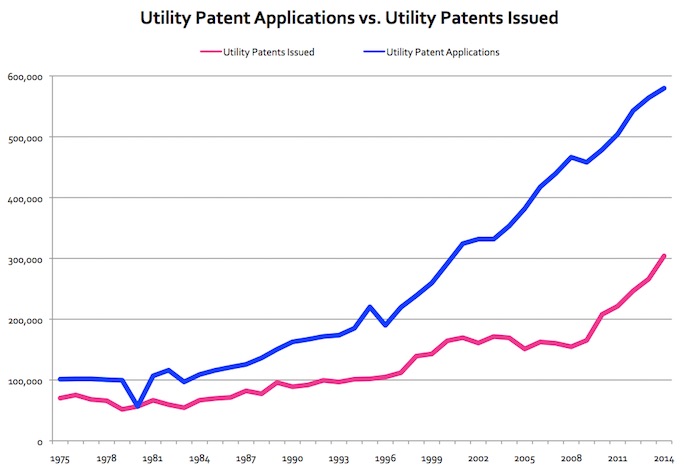
Increasingly, patent attorneys are charging on a flat fee or project basis rather than on an hourly basis. Having said that, even with a flat or project fee, the amount quoted will in one way or another reflect the amount of time the attorney will spend on the project. So if you get a flat fee quote for $7,500 you should not expect $15,000 worth of service.
Fees for patent attorneys are going to vary quite significantly depending upon the geographical market and the attorney’s level experience. Based on 2011 economic data, the national average for a partner level attorney is $441 per hour, the national median is $410.00 per hour, the 25th percentile is $325.00 per hour and the 75th percentile is $535.00 per hour. Cities like Boston, New York and San Francisco tend to be the most expensive (where the average is $555 to $570 per hour). Texas, Chicago and Washington, D.C. also tend to be more expensive than most other parts of the country, but not as significantly so when compared to Boston, New York and San Francisco.
If you are looking for experienced patent attorneys at a reputable firm you should anticipate hourly rates to be a minimum of $300 per hour in areas outside major metropolitan areas and somewhere between $400 to $700+ per hour in major metropolitan areas.
You may also want to consider working with a patent agent. Although patent agents are not attorneys and do not have the same breadth of legal knowledge, there are certainly many competent patent agents and even those with 5+ years of experience generally charge $200 to $400 per hour.
If you are looking for the best bargain but still want to hire an experienced attorney you should look to non-traditional patent markets. The cost of doing business for patent attorneys in non-traditional markets is typically much less than for attorneys in major metropolitan areas, such as New York or San Francisco, where rent and other costs can be extremely high. In fact, you may be able to afford to have a partner with many years of experience work on your invention for less than you would have to pay an associate with little or no experience at a big city law firm. Nevertheless, you should not just race to the firm with the lowest prices. Invariably, those offering bargain pricing are going to provide you with comparatively less time and service. Be sure to do your homework before hiring patent attorneys offering low fees.
With respect to the estimate of how many attorney hours it would take is difficult without a good deal of information about the invention and/or what if any other, similar inventions are in the prior art. Here is an idea of what you might expect.
 The first step in the process is usually undertaking a patent search to determine whether moving forward make sense. While you can and should do your own patent search initially, at some point in the process you will likely want to obtain a professional patent search, which itself usually runs from $500 to $1,000, with the price depending upon the technology involved. If both a US and international patent search is desired the cost does go up. It is important to understand that the cost of the patent search is a fixed, non-negotiable cost because patent attorneys will outsource the search to firms who specialize only in finding prior art, much like is commonly the case in real estate transactions where attorneys hire title search companies who provide the information necessary for the attorney to review.
Upon receiving the patent search the patent attorney will review the search and issue a patentability opinion (either verbal or in writing, depending upon your preference and other considerations). The price of the patentability opinion can range quite a bit depending upon the complexity of the prior art found, the volume of prior art found, and the amount of written analysis requested. Written analysis can range from a brief opinion letter that is 1 page to a comprehensive assessment that may be 8 to 10 pages long, depending upon the technology. Additionally, a patentability opinion can and frequently is influenced by the complexity of the invention being search. A low range estimate for a 1-page patentability opinion would be $500 to $1,000. Again, it is important to remember that the complexity of the field of invention and number of related patents greatly affects the likely expenditure.
After the search and the patentability opinion or consultation it is up to you, the inventor, to give the green light to move forward. It is worth noting that the critical question for the inventor is not whether a patent can be obtained, but rather a commercially useful patent can be obtained. If you layer enough specifics together it is usually possible to get a patent issued, but the more specifics the less commercially useful the patent will be because it will be easy to get around the rights obtained. Thus, the relevant question should be whether the protection that can likely be achieved is worth the expense of filing a patent application.
If you give the green light your patent attorneys will then start working on the application. It is very difficult if not impossible to give a ballpark estimate for costs without knowing a good bit about the. I strongly suggest that new clients start with a patent search so that we can learn about the invention and the prior art. This has benefits because it may be the case that moving forward does not make sense. If you do move forward after a search the patent application will be better because you will know what traps may lie ahead and it gives your patent attorney the ability to describe your invention in a way that accentuates the positive and distinguishes the invention over the prior art.
For those interested in more information about the approximate cost for the patent process please see The Cost of Obtaining a Patent in the US and US Patent Office Fees.
![[Advertisement]](https://ipwatchdog.com/wp-content/uploads/2024/04/UnitedLex-May-2-2024-sidebar-700x500-1.jpg)
![[Advertisement]](https://ipwatchdog.com/wp-content/uploads/2024/04/Artificial-Intelligence-2024-REPLAY-sidebar-700x500-corrected.jpg)
![[Advertisement]](https://ipwatchdog.com/wp-content/uploads/2024/04/Patent-Litigation-Masters-2024-sidebar-700x500-1.jpg)

![[Advertisement]](https://ipwatchdog.com/wp-content/uploads/2021/12/WEBINAR-336-x-280-px.png)
![[Advertisement]](https://ipwatchdog.com/wp-content/uploads/2021/12/2021-Patent-Practice-on-Demand-recorded-Feb-2021-336-x-280.jpg)
![[Advertisement]](https://ipwatchdog.com/wp-content/uploads/2021/12/Ad-4-The-Invent-Patent-System™.png)






Join the Discussion
6 comments so far.
Steve
April 20, 2015 06:31 pmWe charge by page for patent drafting and have done so for about 8 years. On average it takes about an hour to write a page ready for filing. The motivation for doing so is that it is the best way we have found to connect the productive work product to the amount billed. A CIP with 6 new pages comes in at a very competitive price.
Another advantage is that if I’m drafting while helping the kids with homework, I don’t need to figure out how many minutes were spent on work and how many on algebra.
Moshe
April 19, 2015 11:43 amBenny,
You wrote “we have found that in at least one EU country the costs are lower than in the non-EPO country where you are licensed (and where our company branch is located”
Yes, but once again there is a cost. I have found that there is no substitute for regular face-to-face meetings between the inventor and the patent attorney (assuming a highly-experienced attorney), especially for complicated technologies and minimizes the risk of information ‘getting lost’.
This is especially true (even critical) for ground-breaking technology and/or for situations where the value of the company depends on each individual patent. I have worked remotely with inventors in the past — this is typically OK for routine technology, or where I have a long history of work with the inventor (i.e. have drafted a large number of their applications in the past), or where the company files a large number of patents and no one patent is critical.
Anon
April 19, 2015 10:11 amExcellent post Moshe.
I think the bottom line there is that patent law remains sovereign-dependent.
Benny
April 19, 2015 09:01 amMoshe,
Cuts both ways, doesn’t it? Start drafting in the US and you run afoul of EU practices. Incidentally, we have found that in at least one EU country the costs are lower than in the non-EPO country where you are licensed (and where our company branch is located).
Moshe
April 19, 2015 08:51 amBenny,
Yeah, but you get a 10 page “German disclosure” with 15 claims — that would be just fine for circa-1990 US case law, but unfortunately, the US courts have made a mess over the past 25 years.
As for hourly rates, I do not think the hourly rates in the EU (certainly in Germany) are less than those in the US — however, in England you can probably get a better deal (if you avoid the large London firms).
Disadvantage of EU counsel —- they are less sensitive to US-specific issues — avoiding US ‘patent profanity,’ avoiding invoking ‘means-for’ language (and including proper support if the court applies it), etc. they are also so obsessed with the EPO claim limitations (one ind. per category, 15 claims total) that they usually do NOT make the effort to claim around art with multiple ind. claims. they also tend to include background sections that are appropriate for the EPO but much less so the US. they also tend to write things in internal communications with clients that might lead to problems if you try to enforce in the USA later. Also, you might have a problem with attorney-client privilege in a US court if you are a US-based client hiring EU-based counsel for the original filing.
Advantage of EU counsel — they are more in tune with ‘ROW’ requirements than US-based counsel. keep in mind that, generally speaking, the law in China/Japan/Korea is MUCH closer to that in the EPO than to that in the USA. Canada and Australia may be somewhat different.
FULL DISCLOSURE — I am licensed in the US (and in one non-EPO foreign country) but I live outside of the USA.
Benny
April 19, 2015 05:37 amA point worth considering – (drawn from our own companies’ experience) – if the intention is to file for protection both in the US and the EU, the preliminary work and drafting can be significantly cheaper in the EU than in the US.