
![[IPWatchdog Logo]](https://ipwatchdog.com/wp-content/themes/IPWatchdog%20-%202023/assets/images/temp/logo-small@2x.png)
Posts Tagged: "injunction"
Efficient Infringement Rewards Copycats and Erodes Competition | IPWatchdog Unleashed
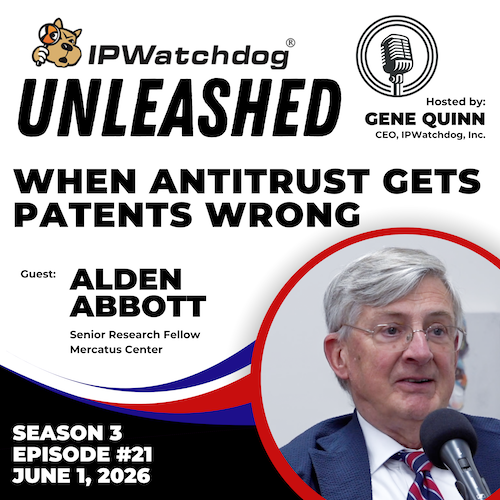
For much of the last four decades, American innovation policy has rested on a premise that should be obvious but too often is not: strong intellectual property rights are not an obstacle to competition. Quite the opposite—strong IP rights are the precursor to robust competition. The alternative to a robust patent system is not some frictionless utopia of open competition. The alternative is secrecy, copying, and underinvestment. If patents are too weak, companies will rely more heavily on trade secrets. That means less disclosure, less technical diffusion, and fewer opportunities for others to build upon what has been invented. Weak patents do not democratize innovation—they often bury it. Weak patents also reward copycats who find it far more expedient and financially rewarding to take rather than to innovate themselves. These truths were the main point at the center of my recent conversation with Alden Abbott, Senior Research Fellow at the Mercatus Center at George Mason University and former General Counsel of the Federal Trade Commission.
Second Circuit Dismisses Zuru’s Appeal in LEGO Copyright/Trademark Case for Lack of Jurisdiction
The U.S. Court of Appeals for the Second Circuit on Tuesday dismissed an appeal from Zuru Inc. in its ongoing copyright and trademark dispute with the Lego group, finding that the court lacked appellate jurisdiction. Lego A/S, Lego Systems, Inc., and Lego Juris A/S first brought claims against Zuru Inc. in 2019, alleging that Zuru’s “First-Generation” toy figurines infringed on the copyright and trademark rights of Lego’s Minifigure. The U.S. District Court for the District of Connecticut granted Lego’s motion for a preliminary injunction, which enjoined Zuru from manufacturing or selling the infringing First-Generation figurines and “any figurine or image that is substantially similar to the Minifigure Copyrights or likely to be confused with the Minifigure Trademarks.”
Federal Circuit Sees Logic in Allowing Expert Testimony on Ordinary Observers in Design Patent Cases
Today, the U.S. Court of Appeals for the Federal Circuit issued a precedential decision in Smartrend Manufacturing Group (SMG), Inc. v. Opti-Luxx Inc. reversing and vacating an infringement ruling from the Western District of Michigan following a jury verdict for patent owner SMG in a case over illuminated school bus signs. In assessing Opti-Luxx’s challenge to Smartrend’s expert testimony offered on the perspective of ordinary observers, the Federal Circuit strongly hinted that such testimony could support design patent infringement allegations by drawing upon relevancy principles from the utility patent context.
UPC Issues First Permanent SEP Injunction: The Ramifications of Philips v. Belkin | IPWatchdog Unleashed
On Friday, October 10, we hosted an impromptu webinar with the intention of using that conversation as our next podcast. While this is not always feasible, because we do often have PowerPoint slides when we host webinars, this webinar was simply a conversation about a very important recent decision of the Unified Patent Court (UPC) without any slides. The case we discuss is Philips v. Belkin, where after the conclusion of all appeals, the UPC issued the first ever final permanent injunction in a case involving standard essential patents (SEPs). So, our conversation this week is about the impact and ramifications of the UPC’s final decision in Philips v. Belkin. We discussed the UPC’s final decision and permanent injunction in Philips v. Belkin with an in-house attorney from Philips and the litigation team at Bardehle Pagenberg in Germany that represented Philips in this important win. By originally having this conversation as a webinar with a live audience, I was able to incorporate questions from the audience, which you’ll hear periodically throughout the podcast.
A Big Win for Small Business Patent Owners: Leveling the Patent Litigation Playing Field
This week on IPWatchdog Unleashed I speak with F. Scott Kieff, former Commissioner on the International Trade Commission, and Joshua Hartman, head of Merchant & Gould’s ITC practice group. Our conversation, which took place on June 4, focused on the landmark ruling by the Federal Circuit in Lashify, Inc. v. International Trade Commission, which was a big win for small business patent owners. We discuss the consequences of the Lashify ruling and the politics of the decision, including whether the decision fits within an America First view of domestic and global markets. Kieff also discusses the historical evolution of the ITC, why it was initially created, and how it is purposefully deadlocked politically to require cooperation.
Ninth Circuit Upholds Injunction for OpenAI Over Dissent’s Charge of Abuse of Discretion
OpenAI, Inc. has won a fight at the U.S. Court of Appeals for the Ninth Circuit to preliminarily enjoin Open Artificial Intelligence, Inc. and its owner, Guy Ravine, from using the marks “OpenAI” or “Open AI” in commerce. But one of the three judges dissented, calling the findings in the district court’s orders granting the injunction “confusing and insufficiently explained.”
Federal Circuit Vacates District Court’s Denial of Antisuit Injunction in FRAND Case
The U.S. Court of Appeals for the Federal Circuit (CAFC) in a precedential decision today vacated a district court’s denial of Lenovo’s request for the court to issue an “antisuit injunction” against Ericsson prohibiting it from enforcing injunctions granted by Brazilian and Colombian courts relating to Ericsson’s 5G standard essential patents (SEPs). The CAFC ruled that the district court erred in determining whether the U.S. lawsuit was dispositive of the South American actions when it concluded that the U.S. action must result in a license between the parties to the standard essential patents (SEPs) at issue.
Magistrate Judge Recommends $54 Million in Damages Against Defaulting Defendants in Abbott Labs Diabetes Test Strips Case
Last week, a magistrate judge in the Eastern District of New York issued a report and recommendation supporting the entry of default judgment and a permanent injunction against 85 corporate and individual defendants sued by U.S. medical device company Abbott Laboratories. While the report recommended denial of Abbott’s motion for prejudgment interest, the magistrate judge found that enhanced damages totaling more than $54 million should be awarded to Abbott for loss of goodwill following the defendants’ unauthorized sale of international versions of Abbott’s FreeStyle Diabetes test strips into the United States.
Fraudulent Trademark Ownership Claims Lead to Near $4 Million Punitive Damages Verdict
On November 8, a Central California jury entered a verdict awarding $3.9 million in punitive damages against Internet financial platform ConsumerDirect. The verdict comes weeks after U.S. District Judge James Selna granted a motion for sanctions after finding that ConsumerDirect fraudulently represented its ownership of unregistered trademarks while obtaining a preliminary injunction in U.S. district court against Array.
Brazil Becoming a Relevant Forum for Telecom Patent Litigation
Unlike other jurisdictions, injunctions in Brazil are no equitable remedy. There is no discretionary power of the court to decide whether to grant a permanent injunction upon the finding of infringement at the end of the proceedings. Injunctive relief is the primary remedy, and it can only be substituted by financial damages at the election of the plaintiff. Preliminary injunctions, on the other hand, are subjected to the discretion of the courts—and must pass a test of balance of hardships.
Eighth Circuit Overturns Injunction for Harassment Allegedly Inspired by Patent Troll Rhetoric
On March 4, the U.S. Court of Appeals for the Eighth Circuit issued a ruling in Tumey v. Mycroft AI, Inc. in which the appellate court overturned the Western District of Missouri’s grant of injunctive relief to Tumey, a patent attorney representing a plaintiff asserting patent claims against Mycroft. The Eighth Circuit found that Tumey had not met the requisite standard of proof to show that Mycroft had engaged in cyber attacks and harassing phone calls targeting Tumey and his family to support injunctive relief. The appellate court also remanded the case with instructions to reassign the case to a different district court judge.
CAFC Affirms Decision Vacating Judgment and Injunction Due to Executive’s Misrepresentations
On May 5, the U.S. Court of Appeals for the Federal Circuit (CAFC) affirmed the decision of the District Court for the Central District of California to vacate a judgment and injunction for Zinus, Inc., holding the district court did not abuse its discretion. The court concluded: “Here, Lawrie, Zinus’s president and expert witness, misrepresented his knowledge of highly material prior art. The district court properly declined to condone such conduct.”
The New U.S. Essential Patents Statement – Safeguarding the Integrity of the Patent System
In withdrawing the 2013 statement, the new 2019 guidance by the DOJ, NIST and the USPTO states the obvious, i.e. that there is no difference in the law between F/RAND assured standard essential patents and all other patents. While some would have perhaps liked to break the unitarity approach of the patent system so as to weaken remedies against the infringement of essential patents, a legal system that would apply a different standard to standard essential patents as opposed to other patents would violate U.S. trade obligations.
The Impact of Overturning eBay v. MercExchange
At a time when most policymakers rightly argue that China and other countries need to do more to clamp down on intellectual property infringement, overturning the four-factor eBay test would impose new hurdles and increase the PAE problem that Congress and the Supreme Court have fought to address over that last two decades. The risk that an implementer engages in “efficient infringement” has made the ITC an increasingly attractive forum, for at least some patent owners and notably not PAEs. ITC exclusion orders and cease and desist orders are the last vestige of the exclusivity promised to the right patent owners at the time they are granted a patent. Compared to proposed sections of the STRONGER Patents Act, the ITC strikes a balance between offering at least some patent owners the ability to prevent infringers from engaging in the never-ending game of “efficient infringement” while frustrating PAEs attempts to abuse the exclusionary remedies offered. Congressional action should be reserved for a time when there is clear evidence that the eBay decision is harming U.S. businesses and those U.S. businesses are unable to obtain the relief they need at the ITC. At this time, there is no such evidence.
USPTO, DOJ & NIST Issue Joint Policy Statement on Injunctions for Standard Essential Patents
Earlier this afternoon, the United States Patent and Trademark Office (USPTO, National Institute of Standards and Technology (NIST) and the U.S. Department of Justice, Antitrust Division (DOJ), issued a Joint Policy Statement on Remedies for Standards-Essential Patents Subject to Voluntary F/RAND Commitments (“2019 Joint Policy Statement”). This Joint Policy Statement explains that “[c]onsistent with the prevailing law… injunctive relief, reasonable…
Varsity Sponsors
![[Advertisement]](https://ipwatchdog.com/wp-content/uploads/2026/05/Protege-in-PatentSight-product-350x250-Ad-A.png)
![[Advertisement]](https://ipwatchdog.com/wp-content/uploads/2026/05/LexisNexis-Jun-11-2026-sidebar-700x500-1.jpg)

Latest IPW Posts
Patents Don’t Monetize Themselves: Turning Portfolios from Cost Centers into Revenue Assets
June 8, 2026 @ 01:32 pmAutomating the Patent Process at the USPTO to Save Inventors Money
June 8, 2026 @ 11:15 amReaders React: What to Expect After the Supreme Court’s Hikma Ruling
June 7, 2026 @ 12:15 pm
Latest Podcasts


IPWatchdog Events
Webinar: How AI Is Transforming IP Strategy Across the Patent Lifecycle
June 11 @ 12:00 pm - 1:00 pm EDTWebinar: AI in Patent Drafting – When to Use Generative AI – and When Not To
June 25 @ 12:00 pm - 1:00 pm EDTFrom IPWatchdog
![[Advertisement]](https://ipwatchdog.com/wp-content/uploads/2021/12/WEBINAR-336-x-280-px.png)
![[Advertisement]](https://ipwatchdog.com/wp-content/uploads/2021/12/Ad-4-The-Invent-Patent-System™.png)