![[IPWatchdog Logo]](https://ipwatchdog.com/wp-content/themes/IPWatchdog%20-%202023/assets/images/temp/logo-small@2x.png)
USPTO’s Stewart to PTAB Masters Attendees: Tell Us Your Story, Focus on the Errors
U.S. Patent and Trademark Office (USPTO) Deputy Director Coke Morgan Stewart joined IPWatchdog’s Founder and CEO Gene Quinn this morning to kick off the Virtual PTAB Masters Program 2026. Discussing the many procedural changes that have been implemented at the Patent Trial and Appeal Board (PTAB) under first Stewart as Acting Director and then current Director John Squires’, Stewart urged patent owners responding to petitions at the PTAB to tell their stories and petitioners to focus on patents in need of clear “error correction.”
Eileen McDermott
23 hours ago
 2
2
![[Advertisement]](https://ipwatchdog.com/wp-content/uploads/2026/01/LexisNexis-Feb-3-2026-banner-1500x500-1.jpg)
CAFC Affirms Non-Infringement Ruling for Hulu Due to Claim’s Requirement of Specific Order of Steps
The U.S. Court of Appeals for the Federal Circuit (CAFC) on Thursday issued a precedential decision affirming a district court decision that Sound View Innovations’ multimedia streaming patent claims were not infringed because Hulu’s “accused products do not perform the claim limitations in the required sequence.” The decision was authored by Judge Chen.
Eileen McDermott
January 29, 2026, 11:15 AM
0
Music Publishers File New Piracy Suit Against Anthropic Alleging Mass Torrenting of Copyrighted Works
Concord Music Group, Inc., Universal Music Group, and ABKCO Music, Inc. filed a complaint on Wednesday for copyright and Digital Millennium Copyright Act (DMCA) violations against Anthropic PBC, Dario Amodei, and Benjamin Mann in the U.S. District Court for the Northern District of California, adding another lawsuit against generative artificial intelligence companies. The publishers alleged that Anthropic engaged in mass piracy by downloading millions of unauthorized copies of books containing their copyrighted musical compositions from notorious pirate library websites, including Library Genesis (LibGen) and Pirate Library Mirror (PiLiMi). The complaint argued that Anthropic used BitTorrent to acquire these works and subsequently trained its Claude AI models on the stolen content, thereby directly infringing the publishers’ exclusive rights and undermining the music licensing market.
Rose Esfandiari
January 29, 2026, 08:15 AM
1
Identifying Trade Secrets Under the DTSA: The Critical Requirement of ‘Reasonable Particularity’
Whether the plaintiff has adequately identified the trade secrets that have allegedly been misappropriated is a commonly litigated and critical issue under the Defend Trade Secrets Act (DTSA). Unlike other types of intellectual property—such as patents, copyrights, and trademarks—where the property has already been identified and registered, trade secrets by definition are secret and cannot be identified publicly without destroying the subject matter of the plaintiff’s legal claim. Yet defendants still need to know what secrets they have allegedly misappropriated, and the court needs to know what the case is about.
Peter J. Toren
January 28, 2026, 03:15 PM
0
Strengthening IP Enables Human Creativity and Economic Mobility | IPWatchdog Unleashed
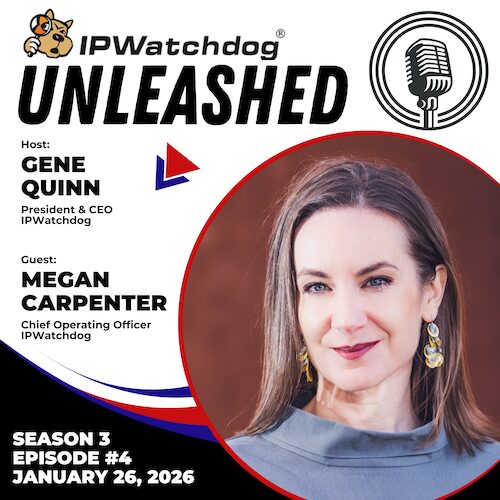
In this week’s episode of IPWatchdog Unleashed, I speak with Megan Carpenter, who just recently stepped down as Dean of UNH Franklin Pierce School of Law after more than eight years. Our conversation was part personal journey and business philosophy together with a candid assessment of the IP ecosystem. We tackle emerging issues, including AI’s impact on legal practice and education. And we discuss the role of IP as essential to sustaining innovation in a rapidly evolving global economy, and fostering human creativity, innovation, and economic mobility.
Gene Quinn
January 27, 2026, 11:56 AM
0
Why PTAB Reform Alone Won’t Save the U.S. Patent System | IPWatchdog Unleashed
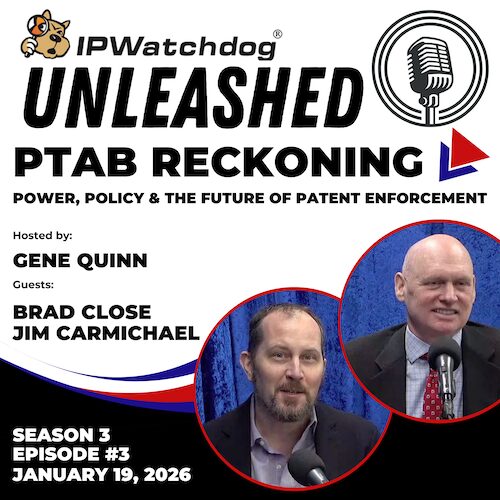
In the latest episode of IPWatchdog Unleashed, I sat down with my good friends Brad Close, who is the Executive Vice President of Transpacific IP, and Jim Carmichael, a former judge on the Board of Patent Appeals and Interferences and founder of Carmichael IP. Brad, Jim and I engaged in a candid conversation that provides our unvarnished assessment of the Patent Trial and Appeal Board (PTAB), where it started historically, where it is today, and where it may finally be headed. Bottom line: the PTAB is no longer the automatic execution squad it once was, but durable patent rights will require reform well beyond the agency level.
Gene Quinn
January 20, 2026, 09:58 AM
1
Patent Reset: 2025’s Pivotal Moments and What Comes Next
As we wind down 2025 it is time to reflect on the year that was, and what the future will bring. This year was punctuated by a structural reset for the U.S. patent system. What unfolded was not just incremental reform, but a coordinated shift driven by leadership change, policy realignment, economic pressure, and accelerating adoption of AI—all converging to reshape how patents are examined, challenged, monetized, and managed. This week on IPWatchdog Unleashed we explore the monumental changes and the biggest trends that impacted the patent and innovation industry during 2025, and which will play an important role in defining 2026.
Gene Quinn
December 22, 2025, 04:05 PM
1
![[Advertisement]](https://ipwatchdog.com/wp-content/uploads/2025/11/PTAB-Masters-2026-banner-regular-price-virtual-CLE-1500x500-1.jpg)
CAFC Affirms District Court’s Ruling That Trade Secrets Were Not Sufficiently Identified Under Statute
The U.S. Court of Appeals for the Federal Circuit (CAFC) on Wednesday affirmed a district court decision finding that Applied Predictive Technologies, Inc. (APT) had failed to sufficiently identify its trade secrets under either the state or federal trade secrets statutes. Business analytics company APT sued MarketDial, Inc. and John Stoddard in the U.S. District Court for the District of Utah for patent infringement and trade-secret misappropriation and later added Morgan Davis as a defendant and added breach-of-contract and tort claims.
Eileen McDermott
January 28, 2026, 01:45 PM
1
DOJ Urges Supreme Court to Deny Cert in Thaler’s Latest Bid to Copyright Work Created by AI
On January 23, the United States Department of Justice (DOJ) urged the U.S. Supreme Court to reject a petition from Stephen Thaler, who seeks copyright protection for a work created by his artificial intelligence (AI) system. The DOJ argued that the U.S. Court of Appeals for the District of Columbia Circuit correctly upheld the United States Copyright Office’s refusal to register a copyright for an image that was admittedly created without human authorship.
Rose Esfandiari
January 28, 2026, 08:15 AM
2
The Supreme Court Should Take Up the USAA Case to Bring Clarity to the Esoteric ‘Abstract Ideas’ Doctrine of Alice
In 2014, the Supreme Court held that an invention is patent-ineligible if directed to “abstract ideas,” but that there was no need to define the term. Alice Corp. Pty. Ltd. v CLS Bank Int’l, 573 U.S. 208, 221. Now, with the experience of more than a decade of confusing and unpredictable decision-making by lower courts trying to apply Alice, it is time for the Supreme Court to step in and provide a definition and workable test for the abstract-ideas exclusion…. The Court should grant the petition for certiorari filed by United States Automobile Association (USAA) in USAA v. PNC Bank on January 14, 2026. That will allow the Supreme Court to address the most basic of questions: What is an abstract idea?
Gene Quinn
January 27, 2026, 06:18 PM
4
Pioneering AI Innovations and Legacy: A Conversation with Inventor Gil Hyatt / IPWatchdog Unleashed
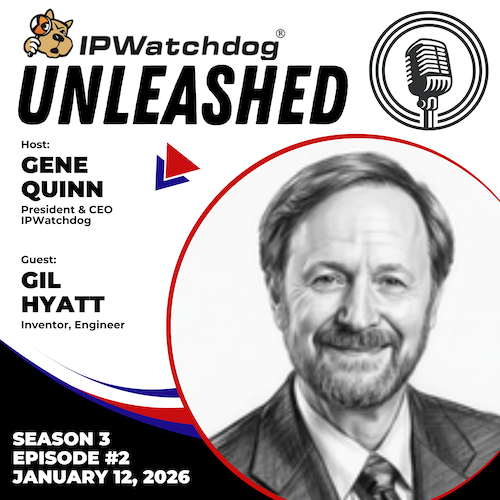
This week on IPWatchdog Unleashed, I sat down with prolific inventor Gil Hyatt, exploring his innovative journey and aspirations to leave a lasting legacy. One of the key highlights of the conversation was Gil’s creation of a non-profit Pioneering AI Foundation, which is aimed at advancing AI technology and bolstering U.S. economic interests. This non-profit organization is set to hold Gil’s substantial portfolio of AI patent applications, which cover his pioneering work dating back to the 1980s, and includes groundbreaking claims in artificial intelligence that could revolutionize sectors like education, manufacturing, and trade.
Gene Quinn
January 13, 2026, 02:15 PM
4
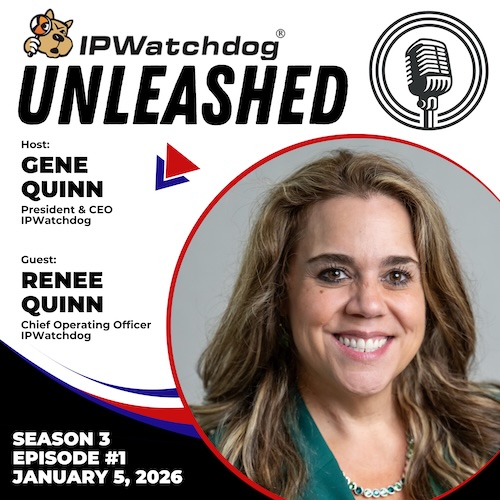
Entrepreneurship, Innovation and Becoming a Patented Inventor: Behind the Scenes with Renee Quinn
This week on IPWatchdog Unleashed, I sat down with my business and life partner, Renee Quinn. In addition to telling Renee’s story about how she found her way into the intellectual property world, and through our sometimes-comical banter, we together explore what it really takes to build, sustain, and continuously reinvent an entrepreneurial company like IPWatchdog. What emerged was a practical roadmap for entrepreneurship, invention, navigating platform risk, and focused on the necessity of constantly being ready to pivot as old business models start to show signs of age and ultimately falter. From Renee’s journey from IP outsider to patented inventor, to firsthand lessons learned navigating Amazon’s reseller ecosystem, the discussion highlights how intellectual property operates in the real world, not the classroom.
Gene Quinn
January 6, 2026, 02:15 PM
1
Navigating the Changing Patent Landscape with Gene Quinn and John White | IPWatchdog Unleashed
This week on IPWatchdog Unleashed, I was joined by my longtime friend John White, who is the the creator of the patent bar review course I’ve taught for almost 27 years. Together we explore the intricate and ever changing patent landscape. First, we begin by discussing the bar exam and how it is changing, then we pivot to the evolving role of AI in patent law more generally. Our conversation traversed decades of personal history, friendship and professional insights, revealing how the industry has transformed over the years and what it means for the current and future generation of patent practitioners.
Gene Quinn
December 2, 2025, 12:15 PM
0
![[Advertisement]](https://ipwatchdog.com/wp-content/uploads/2026/01/LIVE-2026-banner-early-bird-with-speakers-1500x500-1.jpg)
Varsity Sponsors
![[Advertisement]](https://ipwatchdog.com/wp-content/uploads/2025/11/PTAB-Masters-2026-sidebar-regular-price-virtual-CLE-700x500-1.jpg)
![[Advertisement]](https://ipwatchdog.com/wp-content/uploads/2025/12/LIVE-2026-sidebar-early-bird-new-700x500-1.jpg)

Latest Podcasts


IPWatchdog Events
Webinar: Masterclass – AI Prompt Engineering for Patent Workflows
February 5 @ 12:00 pm - 1:00 pm ESTCLE Webinar: How to Prompt AI – A Hands On Workshop for Patent Prep and Pros
February 10 @ 12:00 pm - 1:00 pm ESTWebinar: Optimizing the Chemistry Drafting Process – Where AI Actually Helps
February 17 @ 12:00 pm - 1:00 pm EST
Industry Events

Subscribe to IPWatchdog
This is the best way to stay informed. We send a daily roundup of our latest news, press releases, and events.
Get Email Updates
Sponsored Content



Recent Podcasts
![[Advertisement]](https://ipwatchdog.com/wp-content/uploads/2021/12/WEBINAR-336-x-280-px.png)

Press Releases