
![[IPWatchdog Logo]](https://ipwatchdog.com/wp-content/themes/IPWatchdog%20-%202023/assets/images/temp/logo-small@2x.png)
Posts in US Supreme Court
Retired Judges Tell SCOTUS Justices to Take Newman Case, Citing ‘Grave Threat’
Seven retired federal judges have filed an amicus brief supporting U.S. Court of Appeals for the Federal Circuit (CAFC) Judge Pauline Newman’s Supreme Court petition seeking review of her case against CAFC Chief Judge Kimberly Moore for what she has dubbed Moore’s “unlawful” removal of Newman from her duties on the court. The judges’ amicus brief argues that “permitting misconduct of the sort alleged here to proceed unchecked and unexamined by the federal courts poses a grave threat to the independence of all federal judges, particularly the 50% of judges who are 68 or older.”
Strike Two for CPC at High Court in Rule 36 Challenge
The U.S. Supreme Court today denied a petition for certiorari challenging the U.S. Court of Appeals for the Federal Circuit’s (CAFC’s) use of Rule 36 summary affirmances in appeals from the Patent Trial and Appeal Board (PTAB). CPC Patent Technologies petitioned the Court in March of this year asking the Justices to consider the question: “Whether the Federal Circuit can affirm a PTAB decision without opinion in contravention of the clear statutory requirement of an ‘opinion’ when reviewing such decisions.”
Supreme Court Denies Cert in Rapunzel Trademark Case
The U.S. Supreme Court on Monday denied a petition for a writ of certiorari filed by Rebecca Curtin, leaving in place a decision by the U.S. Court of Appeals for the Federal Circuit (CAFC) that barred her from opposing the trademark registration for “RAPUNZEL” for dolls and toy figures. The Court declined to review the CAFC’s holding that a consumer lacks the statutory entitlement to oppose a trademark registration under 15 U.S.C. § 1063 because such consumer interests fall outside the commercial zone of interests protected by the Lanham Act.
The Supreme Court Picks the Wrong Patent Fight in Hikma v. Amarin
The Supreme Court’s decision to hear Hikma Pharmaceuticals USA Inc. v. Amarin Pharma, Inc. is puzzling—and revealing. On its face, the case presents a narrow question: whether a generic drug manufacturer can be held liable for inducing patent infringement based on how it markets a product approved under a so-called “skinny label.” The dispute turns on whether Hikma’s conduct plausibly encouraged physicians to prescribe its generic drug for a patented use. But the Court’s decision to grant certiorari reflects something broader: a continued focus on lowering drug prices through faster generic entry, even at the risk of undermining the patent incentives that make pharmaceutical innovation possible.
SCOTUS Says Fifth Circuit Must Reconsider Contributory Infringement Ruling for Record Labels after Cox v. Sony
The U.S. Supreme Court today granted certiorari to a petition brought by internet service provider (ISP) Grande Communications Networks LLC, appealing from a U.S. Court of Appeals for the Fifth Circuit decision that upheld a jury verdict holding Grande Communications liable for contributory infringement against a group of major U.S. record labels. The Supreme Court granted certiorari and then vacated the judgment and remanded the case to the Fifth Circuit for reconsideration under the Court’s recent opinion in Cox Communications, Inc. v. Sony Music Entertainment.
U.S. Government Says SCOTUS Should Skip Pharma Companies’ Challenge to Medicare Negotiation Program
The U.S. government filed its brief in opposition yesterday to Janssen Pharmaceuticals and Bristol Myers Squibb Company’s (BMS) petition for writ of certiorari challenging the government’s Medicare Drug Price Negotiation Program. A split U.S. Court of Appeals for the Third Circuit decision in September 2025 affirmed a grant of summary judgment to the government that the imposition of the Program via the Inflation Reduction Act (IRA) does not violate the companies’ constitutional rights.
Supreme Court Reverses $1 Billion Verdict, Rules Cox Not Contributorily Liable for Subscribers’ Copyright Infringement
The U.S. Supreme Court on Wednesday reversed a decision by the U.S. Court of Appeals for the Fourth Circuit, ruling that internet service provider Cox Communications, Inc., is not contributorily liable for its subscribers’ copyright infringement. In a 7-2 decision authored by Justice Thomas, the Court held that a service provider is contributorily liable for a user’s infringement only when it intended for its service to be used in that way, which is established only if the provider either encouraged the infringement or designed the service specifically to facilitate it.
SCOTUS Grants Solicitor General Divided Argument in Hikma Induced Infringement Case
The U.S. Supreme Court on Monday granted the Solicitor General’s motion for leave to participate in oral argument as amicus curiae and for divided argument in Hikma Pharmaceuticals USA Inc. v. Amarin Pharma, Inc., a case concerning induced patent infringement in the pharmaceutical skinny label context. The order followed the filing of a merits response brief by Amarin on March 20, defending the U.S. Court of Appeals for the Federal Circuit (CAFC) decision that found Amarin plausibly alleged that Hikma Pharmaceuticals actively induced infringement of patents covering uses of Amarin’s cardiovascular drug Vascepa.
SCOTUS Denies Pro Se Inventor Challenge to Conflicting, Unexplained Section 101 Rejections
Today, the U.S. Supreme Court issued an order list denying a petition for writ of certiorari filed by inventor Noah Healy to challenge rulings upholding a patent examiner’s subject matter eligibility rejection under 35 U.S.C. § 101 at the U.S. Patent and Trademark Office (USPTO). Healy’s pro se petition challenged the U.S. Court of Appeals for the Federal Circuit’s decision to affirm the examiner’s rejection as violating the meaningful review requirements of the Administrative Procedures Act (APA) due to conflicting statutory theories on patentability that were never sufficiently explained by the agency.
The Supreme Court Must Revisit Prosecution Laches—And the Industry Should Speak Up
The latest chapter in the long-running saga of inventor Gil Hyatt is beginning to unfold. The current fight is over prosecution laches—and whether the doctrine even exists. In his last appeal to the Federal Circuit, Hyatt argued that prosecution laches is not available in Section 145 proceedings because it is inconsistent with the Patent Act of 1952, as confirmed by recent U.S. Supreme Court rulings in Petrella v. Metro-Goldwyn-Mayer (2014) and SCA Hygiene Products Aktiebolag v. First Quality Baby Products (2017). Whether Hyatt is correct about prosecution laches being inconsistent with the 1952 Patent Act, it is clear that the Supreme Court has unequivocally ruled in both Petrella and SCA that laches simply does not exist when there is a statutorily prescribed timeframe to act.
Thoughts on Finesse Wireless‘s Framing of Datascope as an ‘Infamous’ Example of Federal Circuit Overreach
In 2008, a medical device company I represented, Datascope Corporation, won a hard-fought victory at the U.S. Court of Appeals for the Federal Circuit. That court reversed a verdict of patent infringement rendered by a federal jury in Baltimore in a suit brought by Johns Hopkins University and its licensee against my client. Johns Hopkins Univ. v. Datascope Corp., 543 F.3d 1342 (Fed. Cir. 2008).
NCLA Revives Newman Case Against Moore with Supreme Court Petition
The New Civil Liberties Alliance (NCLA) has filed a petition for a writ of certiorari asking the U.S. Supreme Court to review its case against U.S. Court of Appeals for the Federal Circuit (CAFC) Chief Judge Kimberly Moore for what the NCLA dubs the “unlawful” removal of Newman from her duties on the court.
SCOTUS Denies Petition Seeking Review of Second Circuit’s Trademark Co-Ownership Ruling
The U.S. Supreme Court on Monday denied certiorari in Zioness Movement, Inc. v. The Lawfare Project, Inc., a case in which Zioness Movement sought review of a U.S. Court of Appeals for the Second Circuit decision that upheld a jury verdict allowing two competing nonprofit entities to co-own the “Zioness” trademark.
SCOTUS Denial of Lynk Labs Petition Preserves Unpublished Patent Applications as Prior Art in Pre-AIA IPRs
Today, the U.S. Supreme Court denied a petition for writ of certiorari filed by LED lighting developer Lynk Labs to challenge the U.S. Court of Appeals for the Federal Circuit’s ruling last January upholding the invalidation of Lynk Labs’ patent claims. The Supreme Court’s denial leaves in place the Federal Circuit’s determination that U.S. patent applications are prior art as of their filing date in inter partes review (IPR) validity proceedings conducted under the pre-America Invents Act (AIA) statute.
Supreme Court Denies Thaler’s Latest Attempt to Register Copyright to AI-Generated Image
Today, the U.S. Supreme Court issued an order list including the denial of a petition for writ of certiorari filed by Dr. Stephen Thaler that challenged federal agency and court rulings preventing copyright registration for an image generated entirely by artificial intelligence (AI). In following the U.S. Solicitor General’s call to deny cert to Thaler’s appeal, the Supreme Court declined invitations from both sides of the AI authorship debate to clarify the copyrightability of works that are substantially AI-generated.
Varsity Sponsors
![[Advertisement]](https://ipwatchdog.com/wp-content/uploads/2026/04/Cypris-April-26-2026-sidebar-left-700x500-1.jpg)
![[Advertisement]](https://ipwatchdog.com/wp-content/uploads/2026/04/Tradespace-Apr-28-2026-sidebar-700x500-1.jpg)
![[Advertisement]](https://ipwatchdog.com/wp-content/uploads/2026/04/Virtual-AI-2026-May-18-19-2026-sidebar-700x500-1.jpg)

Latest IPW Posts
Retired Judges Tell SCOTUS Justices to Take Newman Case, Citing ‘Grave Threat’
April 21, 2026 @ 04:15 pmDespite Growing Number of IP Advocates in Congress, C4IP Scorecard Finds Weak IP Engagement Overall
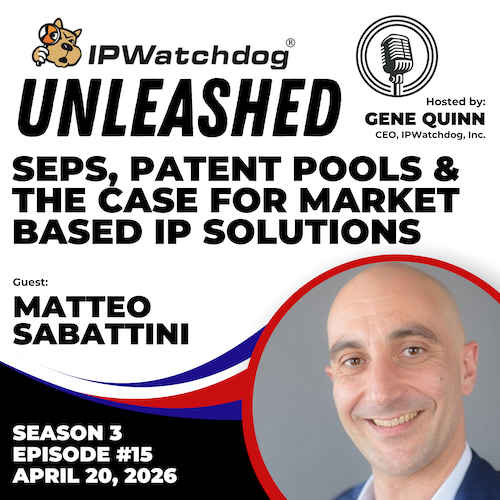
April 21, 2026 @ 12:30 pmSEPs, Patent Pools and the Case for Market-Based IP Solutions | IPWatchdog Unleashed
April 21, 2026 @ 11:33 amStrike Two for CPC at High Court in Rule 36 Challenge
April 20, 2026 @ 02:47 pmSupreme Court Denies Cert in Rapunzel Trademark Case
April 20, 2026 @ 02:15 pm
Latest Podcasts

IPWatchdog Events
Webinar: Beyond Patent Data – Unifying IP and R&D with AI-Driven Intelligence
April 23 @ 12:00 pm - 1:00 pm EDT
Industry Events
Risk, Red Flags, and Reality: What secure AI looks like in patent law
April 30 @ 12:00 pm - 12:45 pm EDT24th Annual Rocky Mountain Intellectual Property & Technology Law Institute
May 28 @ 8:30 am - May 29 @ 4:30 pm MDTFrom IPWatchdog
![[Advertisement]](https://ipwatchdog.com/wp-content/uploads/2021/12/WEBINAR-336-x-280-px.png)
![[Advertisement]](https://ipwatchdog.com/wp-content/uploads/2021/12/Ad-4-The-Invent-Patent-System™.png)