![[IPWatchdog Logo]](https://ipwatchdog.com/wp-content/themes/IPWatchdog%20-%202023/assets/images/temp/logo-small@2x.png)
Posts in Capitol Hill
Copyright Office Solicits Comment on Music Streaming Fraud
Today, the U.S. Copyright Office published a notice of inquiry (NOI) in the Federal Register soliciting public comment on issues related to music piracy threatening billions in U.S. domestic revenues generated by digital streaming. The Office’s NOI responds to a request into the prevalence of streaming fraud across the music industry issued by U.S. Representative Scott Fitzgerald (R-WI), who also voiced concerns about generative artificial intelligence’s (AI) impact on the music industry.
When Did Medical Innovation Become a Bad Thing?
Congress has been holding hearings on pharmaceutical patents and drug prices, along with U.S. Patent and Trademark Office (USPTO) fee-setting and oversight. During these hearings, America’s pharmaceutical innovators face an unusual criticism: They are accused of abusing the patent system not only when they invent new medicines, but also when they improve them.
Senate IP Subcommittee Focuses on Fee-Setting, PTAB Rule in USPTO Oversight Hearing
U.S. Patent and Trademark Office (USPTO) Director John Squires faced the Senate Judiciary Committee’s Subcommittee on Intellectual Property Tuesday in an oversight hearing pushing for more information on several of the policy changes his administration has put in place. The hearing was the last over which its current Chairman, Senator Thom Tillis (R-NC), will preside.
D.C. Judge Pauses Perlmutter Suit as Copyright Office Bill Awaits Senate Action
The U.S. District Court for the District of Columbia issued a minute order on September 18, in Perlmutter v. Blanche, staying the lawsuit brought by Register of Copyrights Shira Perlmutter until December 18, 2026. Judge Timothy J. Kelly pointed to the House of Representatives’ June passage of the Legislative Branch Agencies Clarification Act, H.R. 6028, which would designate the Register of Copyrights as an officer “appointed by the President” with the advice and consent of the Senate.
New Bill Would Overhaul Judicial Misconduct Proceedings in Light of Moore-Newman Battle
Representative Scott Fitzgerald (R-WI) has introduced a bill to amend the Judicial Conduct and Disability Act, inspired by U.S. Court of Appeals for the Federal Circuit (CAFC) Judge Pauline Newman’s fight to restore her status as an active judge, following a three-year suspension of her duties initiated by CAFC Chief Judge Kimberly Moore.
Issa Hesitant to Renew USPTO Fee-Setting Authority Amid PTAB Changes
The House Judiciary Committee’s Subcommittee on Courts, Intellectual Property, Artificial Intelligence, and the Internet held an oversight hearing today to consider its role in renewing the U.S. Patent and Trademark Office’s (USPTO’s) fee setting authority. Throughout the hearing, Subcommittee Chairman Darrel Issa (R-CA) expressed skepticism about USPTO Director John Squires’ recent changes to discretionary denial practice at the Patent Trial and Appeal Board (PTAB) and wondered whether renewal of such authority under the America Invents Act (AIA) should be conditioned on reforms to the agency’s policy.
From Testimony to Action: Proposed Legislation to Address Issues Raised by Rights Owners During Recent House Hearing
On June 30, 2026, the House Judiciary Subcommittee on Courts, Intellectual Property, Artificial Intelligence, and the Internet held a hearing titled, “A Midlife Crisis? IP and the Internet After 40,” which examined whether current U.S. intellectual property laws and enforcement mechanisms are effective against Internet-driven infringement and counterfeiting. The hearing focused on online counterfeiting, digital piracy, and AI-enabled or generated infringement and digital replicas. The hearing also considered the difficulty in enforcing rights against overseas operators, and enforcement tools to address these issues, including Schedule A litigation and website blocking.
Issa Introduces Bill to Name Main CAFC Courtroom after Judge Pauline Newman
Representative Darrell Issa (R-CA), Chairman of the Subcommittee on Intellectual Property, Artificial Intelligence, and the Internet, has introduced a bill to designate courtroom 201 at the Howard T. Markey National Courts Building located at 717 Madison Place NW, Washington, DC, as the “Pauline Newman Courtroom”. Room 201 is the main courtroom of the U.S. Court of Appeals for the Federal Circuit (CAFC).
Congress Said No to Stolen Trademarks; The USPTO Said Yes
On December 31, 1959, Calixto Lopez led armed men into the Arechabala family’s rum distillery in Cárdenas, Cuba. The family had made rum there since 1878, building Havana Club into a brand whose English name reflected its success in the U.S. market. According to testimony Ramón Arechabala gave the Senate Judiciary Committee in 2004, Lopez pointed a machine gun at him and announced he was taking over as “Pepe,” the nickname of the company’s president and Ramón’s uncle. The family’s rum business now belonged to the Cuban government.
Tillis Signals Willingness to Tweak PERA Amid Gene Patenting Concerns
The full U.S. Senate Judiciary Committee held a hearing Tuesday, titled “From Genes to Machines: the Patent Eligibility Debate,” during which witnesses testified about the pros and cons of reforming U.S. patent eligibility law, with human genome patentability featuring as a key sticking point. While the hearing became heated at times—mostly over the peripheral topic of drug pricing—witnesses and Committee members ultimately seemed willing to work together on language that might move the bill forward.
The Supreme Court Broke Patent Eligibility: Congress Can Fix It
When the Senate Judiciary Committee examines the Patent Eligibility Restoration Act (PERA) this week, lawmakers won’t simply be debating patent law. They’ll be deciding whether America remains the best place in the world to invent tomorrow’s technologies. That question has taken on new urgency following a series of Supreme Court decisions. In the wake of those rulings, inventors, investors, and even judges have struggled to determine whether many groundbreaking discoveries qualify for patent protection.
House IP Subcommittee, Witnesses Urge Action on Site Blocking Mechanism, NO FAKES
The House Judiciary Committee’s Subcommittee on Courts, Intellectual Property, Artificial Intelligence, and the Internet held a hearing on Tuesday, titled “A Midlife Crisis? IP and the Internet After 40.” The hearing examined the changes that have occurred over the last four decades of the internet and featured witnesses including celebrities, academics and computer and media experts.
Senate Finance Committee Hears from ITC Nominees
The United States Senate Committee on Finance today held a hearing to consider the nominations of five individuals to be Commissioners of the International Trade Commission (ITC). Two of the nominees—Peter-Anthony Pappas (R) and David Foley (R)—have played key roles in IP policy on the Hill over the last several years. Introducing Pappas was Senator Thom Tillis (R-NC), under whom Pappas presently serves as Director of Intellectual Property Policy for the Senate Judiciary Committee, where Tillis Chairs the Subcommittee on Intellectual Property (IP).
Senate Judiciary Moves NO FAKES Act One Step Closer to Passage
The full Senate Judiciary Committee on Thursday unanimously advanced the “Nurture Originals, Foster Art, and Keep Entertainment Safe Act of 2026” (NO FAKES Act), which would create a federal IP right to an individual’s voice and likeness. The Judiciary Committee unanimously voted to report the bill to the full Senate today. Senator Coons said in his remarks on the bill that with the capabilities of current and future AI technology, a personal right to control one’s voice and likeness is imperative.
Anti-Pharma Patent Bills Advance During Senate HELP Committee Hearing
The Senate Health, Education, Labor & Pensions (HELP) Committee held a hearing today during which they debated and ultimately advanced two bills targeting brand pharmaceutical companies. Committee Chairman Bill Cassidy (R-LA) led the hearing, urging fellow Republicans not to be fooled by what he called the “hostage taking theatrics” of Senator Bernie Sanders (D-VT). Sanders, the Committee’s Ranking Member, introduced nine amendments to the “Ensuring Timely Access to Generics Act,” which was ultimately not voted on.
Varsity Sponsors
![[Advertisement]](https://ipwatchdog.com/wp-content/uploads/2026/10/IP-Copilot-Oct-13-2026-sidebar-700x500-1.jpg)
![[Advertisement]](https://ipwatchdog.com/wp-content/uploads/2026/10/Junior-Oct-15-2026-sidebar-700x500-1.jpg)
![[Advertisement]](https://ipwatchdog.com/wp-content/uploads/2026/10/BlackBox-IP-Oct-20-2026-sidebar-700x500-1.jpg)
![[Advertisement]](https://ipwatchdog.com/wp-content/uploads/2026/09/WE-BUY-PATENTS-SIM-IP-Ad-1-revised-on-Sep-28-2026-700x500-1.jpg)
![[Advertisement]](https://ipwatchdog.com/wp-content/uploads/2026/09/Life-Sciences-2026-sidebar-early-bird-date-corrected-700x500-1.jpg)
From the IPWatchdog Institute
![[Advertisement]](https://ipwatchdog.com/wp-content/uploads/2024/09/Patent-Prosecution-Training-sidebar-700x500-2025-03-27.jpg)

Latest IPW Posts
Postcards from WIPO: What’s Ahead for IP in Geneva This Fall
October 8, 2026 @ 12:14 pmChallenging the Validity of an EU Trademark Outside the Courtroom: The CJEU Advocate General’s Approach
October 8, 2026 @ 11:15 amAI Verification and Trade Secrets: A Cross-Border Framework
October 8, 2026 @ 09:15 amCopyright Office Solicits Comment on Music Streaming Fraud
October 7, 2026 @ 03:15 pm
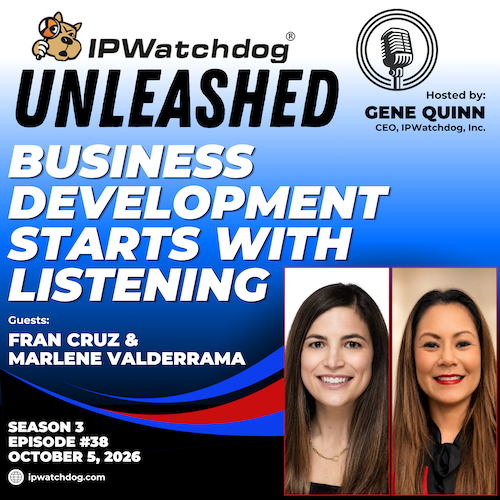
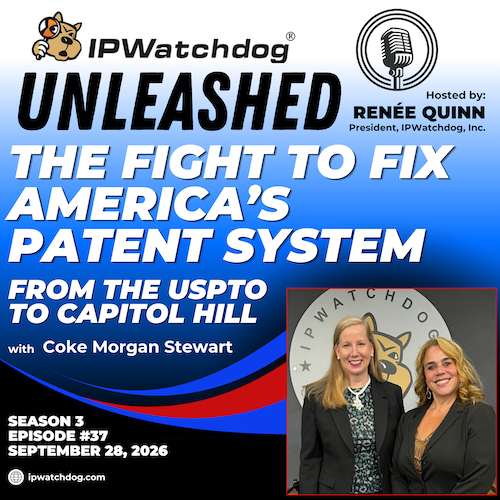
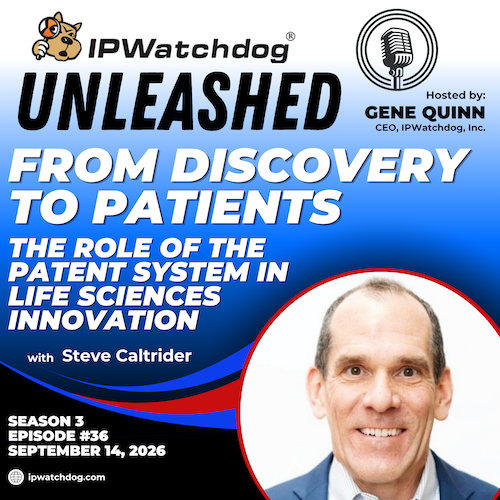
Latest Podcasts

IPWatchdog Events
CLE Webinar: Protecting the Product – Mapping Features to Patent Claims and Closing Coverage Gaps
October 13 @ 12:00 pm - 1:00 pm EDTCLE Webinar: How to Prompt AI – University IP Workflows in Action
October 15 @ 12:00 pm - 1:00 pm EDTWebinar: Leveraging AI for Patent Administration – Expanding Capacity Without Expanding Headcount
October 20 @ 12:00 pm - 1:00 pm EDTWebinar: Patent Search in the AI Era – Separating Hype from Real Productivity Gains
October 22 @ 12:00 pm - 1:00 pm EDTWebinar: AI for Patent Licensing – Beyond Statistical Triage to Evidence-Grounded Product Analysis
October 28 @ 12:00 pm - 1:00 pm EDT
Industry Events
Words Matter: The Overlooked Statements Behind Claim Construction
October 13 @ 1:00 pm - 2:00 pm EDTFrom IPWatchdog
![[Advertisement]](https://ipwatchdog.com/wp-content/uploads/2021/12/WEBINAR-336-x-280-px.png)
![[Advertisement]](https://ipwatchdog.com/wp-content/uploads/2021/12/Ad-4-The-Invent-Patent-System™.png)