
![[IPWatchdog Logo]](https://ipwatchdog.com/wp-content/themes/IPWatchdog%20-%202023/assets/images/temp/logo-small@2x.png)
Posts in Guest Contributors
The True Cost of Patent Infringement Litigation: Enforcement and Defense in a Complex Market
Patent infringement litigation is often discussed in terms of high-profile disputes or headline verdicts. What receives less attention is the cost of getting there. Whether a company is enforcing its patent rights or defending against a claim, the financial impact of patent litigation can be significant long before a case ever reaches trial. For many businesses, particularly those operating in technology-driven industries, patent litigation is no longer just a legal issue. It is a business consideration that can influence strategy, resource allocation and long-term planning.
In re Mitchell: Why the Second AI Didn’t Save Him
Using one associate to prepare a claim construction chart and a second to check it is ordinary practice. In In re Brian E. Mitchell, Proceeding No. D2026-16, a patent attorney did the same with two generative AI tools: one to draft proposed claim constructions and a second to review them. Erroneous citations still reached the district court, and the U.S. Patent and Trademark Office’s (USPTO’s) Office of Enrollment and Discipline (OED) publicly reprimanded him for that.
Biosimilars in Brazil: Intellectual Property, Regulatory and Market Landscape
Biological drugs, or biologics, are now a well-established class of therapeutic products worldwide. Unlike conventional small-molecule drugs, which are generally obtained through chemical synthesis and have relatively simple and well-defined structures, biologics are derived from living organisms or produced through biotechnology processes involving living cells. They include, among others, monoclonal antibodies, recombinant proteins, vaccines, hormones, blood-derived products and advanced cell-based therapies.
Practice Makes Permanent: How AI Can Be Used Effectively for Patent Training
Recent discussions about artificial intelligence (AI) in legal practice tend to split into two opposing positions. One holds that junior attorneys should not meaningfully use AI because it will interfere with their development and prevent the formation of sound legal judgment. The other holds that AI will replace junior attorneys by eliminating the tasks they traditionally performed. Both positions rest on the same hidden assumption, which is that AI carries a direction of its own and that the profession’s task is to decide whether to accept it or resist it.
What U.S. Investors Actually Look for During IP Due Diligence in African Startups
African tech funding just had its strongest year since the 2022 peak…. That discipline shows up nowhere more clearly than in due diligence, and increasingly, that due diligence includes a hard look at intellectual property. For African founders raising from U.S. investors, and for U.S. funds evaluating African deals, understanding what actually gets scrutinized is no longer optional. It can determine whether a term sheet survives diligence intact, gets repriced, or falls apart entirely.
Literally False or Merely Misleading: Why a False Advertising Verdict Is Not a Meta-Analysis
A Lanham Act false advertising verdict is not a scientific meta-analysis. It does not pool evidence, weight studies by quality, or resolve heterogeneity. It allocates burdens and asks whether the party carrying one carried it on the record that party chose to build. Read a false advertising judgment for more than that — for what the science shows, for whether the product works — and you will misread it.
The Application File Never Really Closes: Implications of Recent Case Law on the Prosecution Record
Patent prosecution is often treated as a sequence of discrete tasks: respond to the office action. Amend the claim. Make the argument. Obtain allowance. Move on. Recent U.S. Court of Appeals for the Federal Circuit decisions show why that model is incomplete. The prosecution record can later shape infringement theories, affect whether a reference qualifies as prior art, and determine whether a statutory avenue for review remains available. The cases arise under different doctrines, but they support one durable conclusion: prosecution is part of the patent’s long-term risk allocation.
In Memoriam: Dan Brown: Inventor, Entrepreneur, Patent Advocate
Inventors lost a champion this week. The sudden passing of Dan Brown, serial entrepreneur, 100+ patent holder, educator and policy activist, will leave a void. Dan was a vocal proponent of a fair intellectual property system, committed to building an equitable one for all inventors and creators.
The 24-Month Provisional: A Better Way for Inventors to Test the Market
Congress should let provisional applications be renewable for an extra year, and then publish them if a nonprovisional is not filed. Filing a nonprovisional is a big deal for small businesses. In some cases the expense pays off because it lets inventors recover from infringers, while in others it does not pay off because the market never develops. Under today’s law, the decision is mostly all or nothing—spend large amounts of money on attorney and United States Patent and Trademark Office (USPTO) fees, or compete in the market without protection.
The Patent Estate Problem: Why Litigation Finance Is the Only Preservation Tool American Inventors Actually Have
Congress and the courts have spent two decades treating patents as active weapons in an ongoing commercial fight. That framing misses what patents actually are to most of the people who own them: inheritable property. Twenty-year terms outlast careers. Portfolios pass to spouses, children, foundations, and trusts. Licensing income can support a family for a generation after the inventor stops working…. The pending fights over funder disclosure — Suggestion 26-CV-8 before the Advisory Committee on Civil Rules, the USITC’s proposed 19 C.F.R. § 210.14a, and S.3826, the Litigation Funding Transparency Act of 2026 — are not really arguments about transparency. They are arguments about whether a solo inventor’s family keeps what the inventor spent 30 years building.
What Does a Patent Notice Letter Actually Require? Understanding ‘Actual Notice’
To prevent innocent individuals from being held liable while acting in good faith, the patent statute requires that patent owners put would-be infringers on notice of their intellectual property rights before they are able to hold them liable for any acts of infringement. But what does a notice letter need for it to count? How granular must it be? Are claim charts required?
ARIPO vs. OAPI: What U.S. Companies Need to Know Before Building an Africa IP Strategy
Every year, U.S. companies expanding into Africa make the same planning mistake: they treat the continent as though it has one intellectual property system. It has two, and choosing the wrong one, or failing to choose at all, can leave a brand or invention unprotected across dozens of countries a company assumed it had already covered. Africa is the only continent with two regional IP registration systems operating side by side. Understanding the difference between them is not a technical footnote. It is one of the first strategic decisions a U.S. company should make before it files anything.
Smucker’s Survives Motion to Dismiss: What the Uncrustables Trade Dress Fight Means for the Private Label Economy
On September 1, a federal judge in the Northern District of Ohio J.M. Smucker Co.‘s trademark and trade dress claims over its crustless, crimped-edge peanut butter and jelly sandwiches. The ruling allows that was filed last October against Trader Joe’s private-label “Crustless Peanut Butter & Strawberry Jam Sandwiches” to proceed to discovery and, potentially, a merits determination on whether a sealed, circular sandwich shape can function as a protectable trademark.
Correcting the Uncorrectable: AI-Assisted Inventorship and Section 256
Under 35 U.S.C. Section 256, one can only correct an inventorship error when the underlying facts and the affected parties can actually be identified, and when the statutory correction procedure can be completed. AI-assisted invention is starting to produce cases where none of that is possible: the development record shows plenty of human activity, but nothing in it establishes which person actually conceived the claimed invention. After Fortress Iron, LP v. Digger Specialties, Inc., No. 2024-2313 (Fed. Cir. Apr. 2, 2026, that kind of gap can turn into a validity problem, not just a paperwork one.
How to Outsmart the Trap of Chinese Support Requirements
In a previous article, the authors showed that Chinese courts ask a different question than U.S. courts — not whether the inventor possessed what is recited in the claim, but whether the scope of the claim matches the Technical Solution that the invention actually contributed to the advance of the art. This difference in underlying premise leads to one conclusion: a U.S.-style specification needs to be adjusted when filed in China. Below, the authors propose several strategies, offered as their personal views.
Varsity Sponsors
![[Advertisement]](https://ipwatchdog.com/wp-content/uploads/2026/09/MarqVision-Oct-6-2026-sidebar-700x500-1.jpg)
![[Advertisement]](https://ipwatchdog.com/wp-content/uploads/2026/10/IP-Copilot-Oct-13-2026-sidebar-700x500-1.jpg)
![[Advertisement]](https://ipwatchdog.com/wp-content/uploads/2026/10/Junior-Oct-15-2026-sidebar-700x500-1.jpg)
![[Advertisement]](https://ipwatchdog.com/wp-content/uploads/2026/09/WE-BUY-PATENTS-SIM-IP-Ad-1-revised-on-Sep-28-2026-700x500-1.jpg)
![[Advertisement]](https://ipwatchdog.com/wp-content/uploads/2026/09/Life-Sciences-2026-sidebar-early-bird-date-corrected-700x500-1.jpg)
From the IPWatchdog Institute
![[Advertisement]](https://ipwatchdog.com/wp-content/uploads/2024/09/Patent-Prosecution-Training-sidebar-700x500-2025-03-27.jpg)

Latest IPW Posts
‘Indefiniteness is Not the Same as Impossibility,’ Says CAFC
October 1, 2026 @ 02:15 pmCAFC Says Trade Secret Owner Forfeited Tortious Interference, Damages Arguments
October 1, 2026 @ 11:15 amThe True Cost of Patent Infringement Litigation: Enforcement and Defense in a Complex Market
October 1, 2026 @ 10:15 amFederal Circuit Dismisses Patent Owner’s Appeal for Lack of Final Judgment Under Rule 54(b)
September 30, 2026 @ 04:41 pmCAFC Says District Court Failed to Provide Sufficient Reasoning for Denying Sanctions, Attorney’s Fees
September 30, 2026 @ 12:53 pm
Latest Podcasts
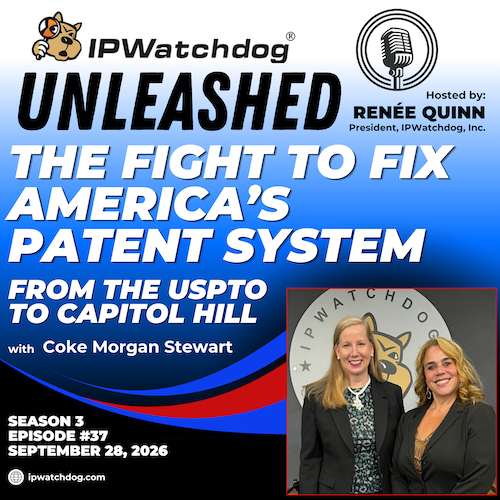



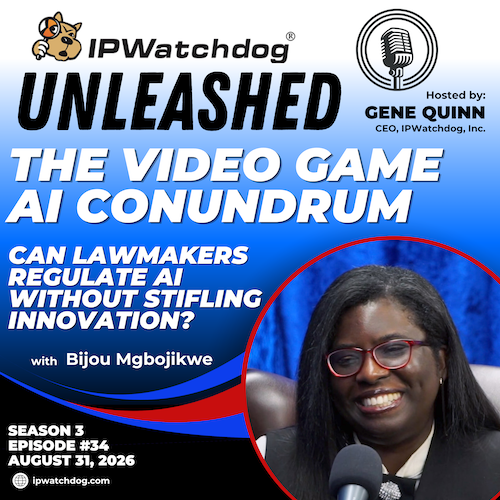
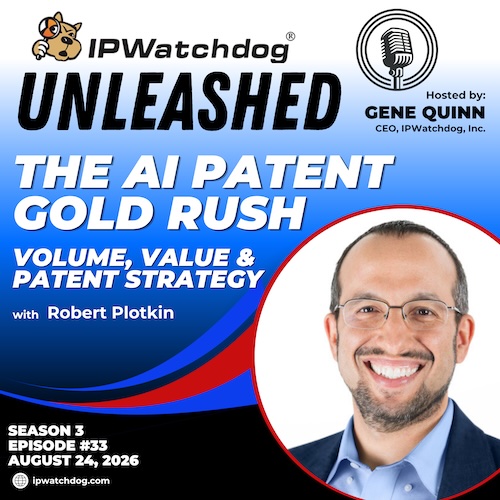
IPWatchdog Events
Webinar: Brand Protection in Asian Marketplaces – Why Takedowns Are Not Enough
October 6 @ 10:00 am - 11:00 am EDTCLE Webinar: Protecting the Product – Mapping Features to Patent Claims and Closing Coverage Gaps
October 13 @ 12:00 pm - 1:00 pm EDTCLE Webinar: How to Prompt AI – University IP Workflows in Action
October 15 @ 12:00 pm - 1:00 pm EDTWebinar: Leveraging AI for Patent Administration – Expanding Capacity Without Expanding Headcount
October 20 @ 12:00 pm - 1:00 pm EDTWebinar: AI for Patent Licensing – Beyond Statistical Triage to Evidence-Grounded Product Analysis
October 28 @ 12:00 pm - 1:00 pm EDT
Industry Events
Words Matter: The Overlooked Statements Behind Claim Construction
October 13 @ 1:00 pm - 2:00 pm EDTFrom IPWatchdog
![[Advertisement]](https://ipwatchdog.com/wp-content/uploads/2021/12/WEBINAR-336-x-280-px.png)
![[Advertisement]](https://ipwatchdog.com/wp-content/uploads/2021/12/Ad-4-The-Invent-Patent-System™.png)