![[IPWatchdog Logo]](https://ipwatchdog.com/wp-content/themes/IPWatchdog%20-%202023/assets/images/temp/logo-small@2x.png)
Posts in IP News
Other Barks & Bites for Friday, October 9: Korean Trademark Probe Shows Royalties Up 69% Since 2018; AAFA Urges USTR to Add Meta to Notorious Markets List; Ninth Circuit Finds Refusal to Deal in Invisalign Antitrust Case
This week in Other Barks & Bites: record quarterly profits reported by Samsung Electronics belie an AI chip shortage likely to last into 2028; a major American apparel industry organization calls for the inclusion of Meta’s Facebook and Instagram in the USTR’s Notorious Markets List; copyright advocates tell Australia’s Parliament that an opt-out framework for AI model training is not feasible; and more.
Postcards from WIPO: What’s Ahead for IP in Geneva This Fall
I am pleased to introduce “Postcard from WIPO,” a new occasional series for the U.S. intellectual property community. Having spent much of my career working on IP issues in the United States, including as Deputy Director of the U.S. Patent and Trademark Office (USPTO), I know how important it is to understand what is happening in the international IP system. From Geneva, I now have a different vantage point on that work, and I would like to share it with you.
Challenging the Validity of an EU Trademark Outside the Courtroom: The CJEU Advocate General’s Approach
A defendant facing an action for infringement of an EU trademark may challenge the validity of that trademark by filing a counterclaim before the EU trademark court. But what happens if the defendant does not do so? Is the opportunity to challenge the trademark’s validity lost, or may the defendant later seek a declaration of invalidity from the European Union Intellectual Property Office (EUIPO)?
Copyright Office Solicits Comment on Music Streaming Fraud
Today, the U.S. Copyright Office published a notice of inquiry (NOI) in the Federal Register soliciting public comment on issues related to music piracy threatening billions in U.S. domestic revenues generated by digital streaming. The Office’s NOI responds to a request into the prevalence of streaming fraud across the music industry issued by U.S. Representative Scott Fitzgerald (R-WI), who also voiced concerns about generative artificial intelligence’s (AI) impact on the music industry.
CAFC Upholds PTAB Indefiniteness Rejections of Pro Se Applicant’s Message Notation Application
The U.S. Court of Appeals for the Federal Circuit (CAFC) issued a decision today in In re Gamble affirming a Patent Trial and Appeal Board (PTAB) decision that sustained an examiner’s rejection of multiple claims of U.S. Patent Application No. 17/490,077 as indefinite under 35 U.S.C. Section 112(b). The CAFC concluded that Oliver Wendel Gamble, who represented himself, forfeited any substantive argument on indefiniteness before the Board and on appeal.
After Three Years, Chief Justice Transfers Newman’s Case to Eleventh Circuit Judicial Council
Following the U.S. Supreme Court’s denial of Judge Pauline Newman’s petition for certiorari in June, the Chief Justice of the United States has transferred Newman’s judicial misconduct case to the Eleventh Circuit Judicial Council. Newman has been asking for her case to be transferred for more than three years. According to an Eleventh Circuit Order published today, the Chief Justice transferred Newman’s complaint “and any pending or new complaints relating to the same subject matter” to the Eleventh Circuit Judicial Council on August 19, 2026.
Federal Circuit Grants Google Mandamus Petition, Directs Transfer of Patent Case to Northern District of California
The U.S. Court of Appeals for the Federal Circuit (CAFC) issued an order Tuesday in In re Google LLC, granting a petition for a writ of mandamus and directing the U.S. District Court for the Western District of Texas (WDTX) to transfer a patent infringement case to the U.S. District Court for the Northern District of California (NDCA). The CAFC concluded that “the decision to deny transfer here was patently erroneous.”
Taiyo, Nakajima & Kato is Seeking a U.S. Patent Attorney (Tokyo, JAPAN)
Taiyo, Nakajima & Kato, a top Japanese patent firm with a long history, is seeking a U.S. patent attorney to work at its main office in Tokyo, Japan. Qualified candidates will be licensed by the USPTO and at least one U.S. state bar, and will have 3-6 years of post-qualification experience filing and prosecuting U.S. patent applications and drafting opinions of counsel. A degree in electrical engineering, chemistry, or biotechnology is preferred, but significant experience in these areas will be considered in conjunction with other technical backgrounds. Japanese language ability, design application experience, litigation support, and previous work as local counsel for foreign firms are also desirable but not required.
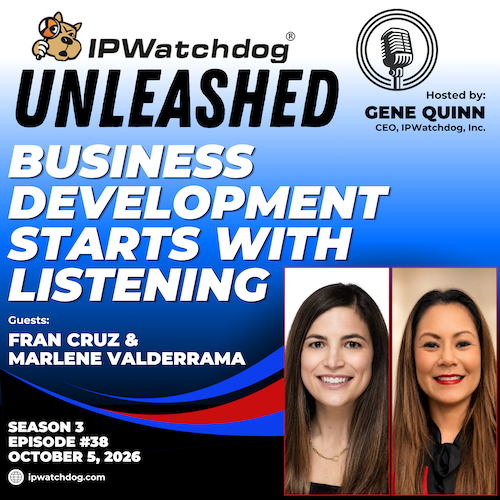
Building Business and Careers Starts with Listening | IPWatchdog Unleashed
This week on IPWatchdog Unleashed, I spoke with Fran Cruz and Marlene Valderrama. Recorded before a live audience following IPWatchdog’s Women’s IP Forum, our conversation explored how professionals build relationships that lead to business, career opportunities, and better ways of doing their jobs. Drawing on their perspectives at Juristat and Halliburton, respectively, Fran and Marlene returned to a fundamental point: earning someone’s attention begins with understanding what matters to them. That requires asking questions and actually listening.
SCOTUS Nixes Petitions Challenging CAFC Apportionment Requirements, Claim Preclusion Rulings
Yesterday, the U.S. Supreme Court issued its first major omnibus order list of the October 2026 term, denying petitions for writ of certiorari in a series of intellectual property-related cases. These denials from the nation’s highest court leave in place contested rulings over the application of apportionment principles to damages in patent and trade secret cases. Other cert denials include appeals to IP-related claims barred under res judicata, including one petition arguing for a manifest injustice exception, and yet another challenge to the Section 101 patent-eligibility inquiry developed at the Federal Circuit.
A Proposal for Addressing the AI Memory Supply Shortage
In economic theory, corporate value creation can be attributed to many factors and conflicting preferences. Prioritizing different factors produces a set of different outcomes and the outcome that is seemingly most efficient becomes the accepted norm. Sometimes however, corporate actors rely on accepted business practices which, while taken in the pursuit of the most optimal outcome, facilitate market distortions. Hit by a compute-driven demand shock and faced with resource scarcity, Samsung, SK Hynix, and Micron have opted to allocate production capacity in a way that has exacerbated an industry- wide memory card supply shortage. But to fully understand why the price of hardware components and consumer electronic devices has been steadily surging, we must first start with Nvidia.
Pro Se Inventor Asks CAFC to Rehear Decision Invalidating Remote Device Finder Claims
Carrie Hafeman, an independent inventor who has been fighting a years-long patent battle against Google and Microsoft, has filed a petition for rehearing of the U.S. Court of Appeals for the Federal Circuit’s (CAFC’s) June 2026 precedential decision affirming Patent Trial and Appeal Board (PTAB) decisions invalidating all claims of three of her patents. Hafeman is pursuing her case pro se after her attorneys recently withdrew.
Federal Circuit Issues Mixed Ruling on Infringement of Powered Cover Plate Patents
The U.S. Court of Appeals for the Federal Circuit (CAFC) issued a decision today in O’Reilly Winship LLC v. SnapRays LLC, reversing in part, affirming in part, and vacating in part a district court’s grant of summary judgment of non-infringement on two powered cover plate patents. The CAFC concluded that claim 1 of one patent is not as limited as the district court determined, and it upheld the district court’s rulings on other disputed claim limitations.
In Memoriam: John F. Witherspoon
John F. Witherspoon, who passed away September 25, 2026, had a stellar career in patent law that spanned more than 50 years. He was devoted to private law practice, government service, and law school teaching. He was a beloved mentor to countless students and younger lawyers and an inspiration to all who knew him.
Federal Circuit Upholds PTAB Enablement Finding Against Dual Herbicide-Degrading Enzyme Patent
The U.S. Court of Appeals for the Federal Circuit (CAFC) issued a decision Friday in Pioneer Hi-Bred International, Inc. v. Inari Agriculture, Inc. affirming a Patent Trial and Appeal Board (PTAB) final written decision that found claims 1 through 33 of a patent on herbicide-degrading enzymes unpatentable for lack of enablement. The CAFC rejected arguments that the PTAB improperly relied on experimental data generated after the patent’s priority date and abused its discretion in crediting an expert witness.
Varsity Sponsors
![[Advertisement]](https://ipwatchdog.com/wp-content/uploads/2026/10/IP-Copilot-Oct-13-2026-sidebar-700x500-1.jpg)
![[Advertisement]](https://ipwatchdog.com/wp-content/uploads/2026/10/Junior-Oct-15-2026-sidebar-700x500-1.jpg)
![[Advertisement]](https://ipwatchdog.com/wp-content/uploads/2026/10/BlackBox-IP-Oct-20-2026-sidebar-700x500-1.jpg)
![[Advertisement]](https://ipwatchdog.com/wp-content/uploads/2026/09/WE-BUY-PATENTS-SIM-IP-Ad-1-revised-on-Sep-28-2026-700x500-1.jpg)
![[Advertisement]](https://ipwatchdog.com/wp-content/uploads/2026/09/Life-Sciences-2026-sidebar-early-bird-date-corrected-700x500-1.jpg)
From the IPWatchdog Institute
![[Advertisement]](https://ipwatchdog.com/wp-content/uploads/2024/09/Patent-Prosecution-Training-sidebar-700x500-2025-03-27.jpg)

Latest IPW Posts
Postcards from WIPO: What’s Ahead for IP in Geneva This Fall
October 8, 2026 @ 12:14 pmChallenging the Validity of an EU Trademark Outside the Courtroom: The CJEU Advocate General’s Approach
October 8, 2026 @ 11:15 amAI Verification and Trade Secrets: A Cross-Border Framework
October 8, 2026 @ 09:15 amCopyright Office Solicits Comment on Music Streaming Fraud
October 7, 2026 @ 03:15 pm
Latest Podcasts



IPWatchdog Events
CLE Webinar: Protecting the Product – Mapping Features to Patent Claims and Closing Coverage Gaps
October 13 @ 12:00 pm - 1:00 pm EDTCLE Webinar: How to Prompt AI – University IP Workflows in Action
October 15 @ 12:00 pm - 1:00 pm EDTWebinar: Leveraging AI for Patent Administration – Expanding Capacity Without Expanding Headcount
October 20 @ 12:00 pm - 1:00 pm EDTWebinar: Patent Search in the AI Era – Separating Hype from Real Productivity Gains
October 22 @ 12:00 pm - 1:00 pm EDTWebinar: AI for Patent Licensing – Beyond Statistical Triage to Evidence-Grounded Product Analysis
October 28 @ 12:00 pm - 1:00 pm EDT
Industry Events
Words Matter: The Overlooked Statements Behind Claim Construction
October 13 @ 1:00 pm - 2:00 pm EDTFrom IPWatchdog
![[Advertisement]](https://ipwatchdog.com/wp-content/uploads/2021/12/WEBINAR-336-x-280-px.png)
![[Advertisement]](https://ipwatchdog.com/wp-content/uploads/2021/12/Ad-4-The-Invent-Patent-System™.png)