
![[IPWatchdog Logo]](https://ipwatchdog.com/wp-content/themes/IPWatchdog%20-%202023/assets/images/temp/logo-small@2x.png)
Posts Tagged: "Capitol Hill"
Despite Growing Number of IP Advocates in Congress, C4IP Scorecard Finds Weak IP Engagement Overall
Today, the Council for Innovation Promotion (C4IP) published the third edition of its Congressional Innovation Scorecard, which provides a measure of each lawmaker in the U.S. Congress in terms of their impact on the nation’s intellectual property (IP) system. Although this year’s scorecard acknowledges higher numbers of pro-copyright bills introduced into Congress, it concludes that members of Congress are still failing to engage fully and effectively on national IP issues to the detriment of America’s future as an innovation leader.
Consumer, Patient Groups Push for Fast Markup of ETHIC Act
A number of groups and individuals self-described as “representing consumers, patients, health care providers, and academic experts in pharmaceutical policy and patent law” have submitted a letter to the U.S. House Judiciary Committee urging members to quickly advance the “Eliminating Thickets to Increase Competition (ETHIC) Act,’’ which was introduced in the House of Representatives last May by Representative Jodey Arrington (R-TX) along with two other Republicans and four Democrats.
As ‘Pro Codes Act’ is Reintroduced, Opponents Warn of Threats to Standards Development System
Opponents of the “Pro Codes Act” are speaking out this week following its recent reintroduction in the U.S. Senate. The Protecting and Enhancing Public Access to Codes (Pro Codes) Act of 2026, S. 4145, was reintroduced on March 19 by Senators Jon Cornyn, Chris Coons, Mazie Hirono, and Thom Tillis. According to the bill’s sponsors, the legislation “ensures safety standards do not lose copyright protection when they are incorporated into law by name so long as they are accessible for free on a publicly available website.”
Contentious House USPTO Oversight Hearing Centers on PTAB Reforms, Trump’s Political Influence
Today, the U.S. House of Representatives Judiciary Committee’s Subcommittee on Courts, Intellectual Property, Artificial Intelligence, and the Internet conducted its first oversight hearing of the U.S. Patent and Trademark Office (USPTO) during the second Trump Administration. The harshest lines of questioning for USPTO Director John Squires during the hearing were reserved for the agency’s notice of proposed rulemaking (NPRM) to reform rules of practice at the Patent Trial and Appeal Board (PTAB) as well as President Trump’s political influence at the agency. During the hearing, Squires also confirmed that the agency’s Patent Public Advisory Committee (PPAC) would soon be revived, following an offer to join PPAC extended last night to an undisclosed independent inventor.
IPWatchdog LIVE Day Three: Coke Stewart Says Reexam Surge is on Office Radar; Rep. Kiley Talks Innovation Education on the Hill; and Meet the 2026 IPWatchdog Masters Hall of Fame Inductees
In the final session of IPWatchdog LIVE 2026 on Tuesday, March 24, U.S. Patent and Trademark Office (USPTO) Deputy Director Coke Morgan Stewart had a conversation with IPWatchdog Founder and CEO Gene Quinn in which she confirmed the Office is paying attention to the recent surge in ex parte reexamination filings and also said she is “optimistic” that the pending Notice of Proposed Rulemaking (NPRM) will be finalized.
Organizations Warn Fast-Track of Bill to Separate Copyright Office from Library of Congress Would Be a ‘Grave Mistake’
Spurred by reports that House leaders are trying to fast-track a bill to separate the U.S. Copyright Office from the Library of Congress, a coalition of consumer rights, industry, open internet and library groups has again sent a letter to the House Committee on Administration urging it to consider the bill on the regular timeline to avoid “unintended consequences.” A full committee markup of the bill is scheduled for tomorrow, March 18,
Opinion: The ITC Has Lost Sight of the Public Interest
Every day, Americans rely on technologies that were unimaginable just a generation ago – from advanced medical devices and artificial intelligence–powered applications to connected consumer electronics. These breakthroughs did not emerge in a vacuum. They are the product of an innovation ecosystem shaped by policy choices. The U.S. International Trade Commission (ITC)—an agency with the extraordinary power to block imports and, in turn, influence the direction of American technology policy—has drifted out of that balance. To align with the Trump Administration’s intellectual property priorities and pro-investment agenda, the ITC is in urgent need of reform.
Tillis and Schiff Want Answers from ALI on Mass Resignations Around Latest Copyright Restatement Project
Senators Thom Tillis (R-NC) and Adam Schiff (D-CA), the Chairman and Ranking Member of the Senate Judiciary Committee’s Subcommittee on Intellectual Property, respectively, sent a letter on Thursday to Director of the American Law Institute Diane Wood asking for answers to 14 questions about the latest Copyright Restatement Project. The letter follows mass resignations from the project last year over concerns about the final product. Specifically, key copyright proponents resigned over what one of those who resigned, Copyright Alliance CEO Keith Kupferschmid, referred to as “a general undercurrent of anti-copyright sentiment that…manifests itself through a disproportionate focus on atypical court decisions that limit the scope of copyright protection.”
PTAB Masters Panelists Predict Rough Road for Pending Patent Bills, Tough Questions from Congress on USPTO Rules, Warn of Widening Gap Between CAFC and USPTO
Panelists at IPWatchdog’s Virtual PTAB Masters Program 2026 last week had some cynical views on chances for pending patent reform bills, while on Friday other experts offered insights into developments at the U.S. Court of Appeals for the Federal Circuit (CAFC) with respect to review of Patent Trial and Appeal Board (PTAB) cases. Speaking on Thursday’s panel, titled “Capitol Hill & PTAB Politics: Innovation Policy, Congressional Oversight and Mid-term Elections,” panelists first addressed the chances of bills such as the Patent Eligibility Restoration Act (PERA) and the Promoting and Respecting Economically Vital American Innovation Leadership (PREVAIL) Act advancing this year.
Iancu Urges House Trade Subcommittee to Address Weakening of U.S. IP Rights By America’s Trading Partners
On Tuesday afternoon, the U.S. House of Representatives Ways and Means Committee’s Subcommittee on Trade convened a hearing titled Maintaining American Innovation and Technology Leadership, which explored a host of regulatory and other legal burdens being placed on tech industry trade by foreign governments to the detriment of American innovators and consumers. Among the panel witnesses at the subcommittee hearing was former U.S. Patent and Trademark Office (USPTO) Director Andrei Iancu, who spoke to several ways that our nation’s adversaries and trading partners alike are weakening American IP rights and how those issues should be addressed by U.S. policymakers.
Issa’s Latest Litigation Funding Bill Debated in House Judiciary Without Reaching Vote
The House Judiciary Committee on Tuesday considered the Protecting Third Party Litigation Funding (TPLF) From Abuse Act as part of a lengthy markup hearing that chiefly focused on escalating immigration enforcement operations in the United States. The bill did not reach a vote after committee members recessed for votes on the House floor and never reconvened. Sources tell IPWatchdog the bill has now been pulled.
The IP Legislation That Shaped 2025 and Prospects for the New Year
As 2025 draws to a close, the intellectual property ecosystem faces a wave of transformative changes driven by artificial intelligence (AI) and evolving legislative priorities. From sweeping federal proposals aimed at harmonizing AI governance and overriding state laws, to new copyright and media integrity measures designed to address deepfakes and transparency, and finally to renewed momentum behind patent eligibility and Patent Trial and Appeal Board (PTAB) reform, these developments signal a pivotal moment for innovators, rights holders, and policymakers alike. This article explores three critical fronts shaping the future of IP: federal AI legislation and executive preemption, copyright accountability and media integrity, and the year-end outlook for patent reform—each redefining the balance between innovation, protection, and compliance.
Senators Introduce Bill to Make Copyright Registration Easier for Visual Artists
Senators Marsha Blackburn (R-TN) and Peter Welch (D-VT) have introduced a bill to streamline the copyright registration process for visual artists, such as photographers, illustrators and graphic artists. According to a press release issued by Blackburn yesterday, “the [copyright] registration process is so bureaucratic and complicated that the time and expense of compliance is too high for high-volume creators like photographers, illustrators, and graphic artists.”
Life Sciences Masters Panelists Lament Mounting Policy Uncertainty
On day one of IPWatchdog’s Life Sciences Masters 2025, panelists addressed a number of looming policy proposals that are negatively impacting the life sciences industry and urged stakeholders to get involved and speak out in order to minimize their effects. An introductory panel that included program sponsors Sherry Knowles of Knowles Intellectual Property Strategies and Robert Sahr of Wolf Greenfield, as well as Becky Kaufman of Ohio State University’s Office of Legal Affairs, discussed topics including Secretary of Commerce Howard Lutnick’s patent tax proposal and the administration’s threats to march in on federally-funded university patents.
Massie to Reintroduce RALIA in Bid to Abolish PTAB
Representative Thomas Massie (R-KY) told US Inventors Conference attendees on Thursday that he will reintroduce the Restoring America’s Leadership in Innovation Act (RALIA). Massie first introduced RALIA in 2021. The bill would repeal the Patent Trial and Appeal Board (PTAB), inter partes review (IPR) and post-grant review (PGR;) return the patent system to a “first-to-invent” model, rather than first-to-file, and would end automatic publication of patents. Inventor groups such as US Inventor and conservative groups have supported the legislation.
Varsity Sponsors
![[Advertisement]](https://ipwatchdog.com/wp-content/uploads/2026/04/Cypris-April-26-2026-sidebar-left-700x500-1.jpg)
![[Advertisement]](https://ipwatchdog.com/wp-content/uploads/2026/04/Tradespace-Apr-28-2026-sidebar-700x500-1.jpg)
![[Advertisement]](https://ipwatchdog.com/wp-content/uploads/2026/04/Virtual-AI-2026-May-18-19-2026-sidebar-700x500-1.jpg)

Latest IPW Posts
Retired Judges Tell SCOTUS Justices to Take Newman Case, Citing ‘Grave Threat’
April 21, 2026 @ 04:15 pmDespite Growing Number of IP Advocates in Congress, C4IP Scorecard Finds Weak IP Engagement Overall
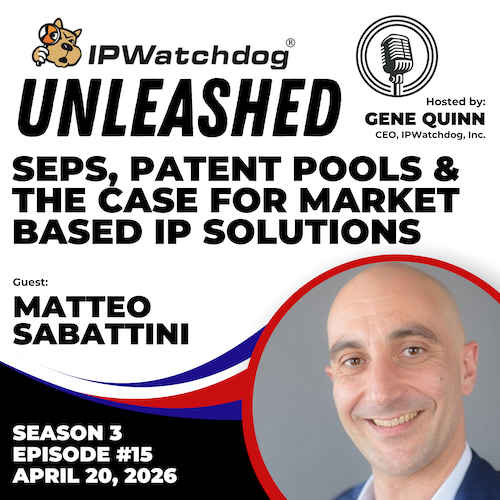
April 21, 2026 @ 12:30 pmSEPs, Patent Pools and the Case for Market-Based IP Solutions | IPWatchdog Unleashed
April 21, 2026 @ 11:33 amStrike Two for CPC at High Court in Rule 36 Challenge
April 20, 2026 @ 02:47 pm
Latest Podcasts



IPWatchdog Events
Webinar: Beyond Patent Data – Unifying IP and R&D with AI-Driven Intelligence
April 23 @ 12:00 pm - 1:00 pm EDT
Industry Events
Risk, Red Flags, and Reality: What secure AI looks like in patent law
April 30 @ 12:00 pm - 12:45 pm EDT24th Annual Rocky Mountain Intellectual Property & Technology Law Institute
May 28 @ 8:30 am - May 29 @ 4:30 pm MDTFrom IPWatchdog
![[Advertisement]](https://ipwatchdog.com/wp-content/uploads/2021/12/WEBINAR-336-x-280-px.png)
![[Advertisement]](https://ipwatchdog.com/wp-content/uploads/2021/12/Ad-4-The-Invent-Patent-System™.png)