
![[IPWatchdog Logo]](https://ipwatchdog.com/wp-content/themes/IPWatchdog%20-%202023/assets/images/temp/logo-small@2x.png)
Posts Tagged: "Patent Litigation"
Federal Circuit Reverses PTAB on Issue Preclusion, Finds Smart Mobile Patent Claims Unpatentable
The U.S. Court of Appeals for the Federal Circuit (CAFC) on Wednesday reversed in part, vacated in part, and remanded a final written decision from the Patent Trial and Appeal Board (PTAB) in an inter partes review (IPR) proceeding filed by Apple, Inc.. The court concluded that the Board was precluded from finding the challenged claims of a patent owned by Smart Mobile Technologies LLC patentable, where a related patent with substantially similar claims had been found unpatentable in a prior IPR.
Split CAFC Says Disputed Aspects of Testimony by Doctor’s Experts are for Jury to Parse
The U.S. Court of Appeals for the Federal Circuit (CAFC) issued a precedential decision on Tuesday, January 20, concluding that a district court abused its discretion in granting motions to exclude two of Dr. Mark A. Barry’s experts and granting judgment as a matter of law (JMOL) to DePuy Synthes Companies. The panel included Judges Stark, Taranto and Prost and Judge Stark dissented. Barry’s U.S. Patent Nos. 7,670,358; 8,361,121; and 9,668,787 cover “surgical techniques and tools for treating spinal deformities, such as scoliosis, that cause vertebrae, which are the small bones forming the backbone, to twist out of alignment,” according to the opinion.
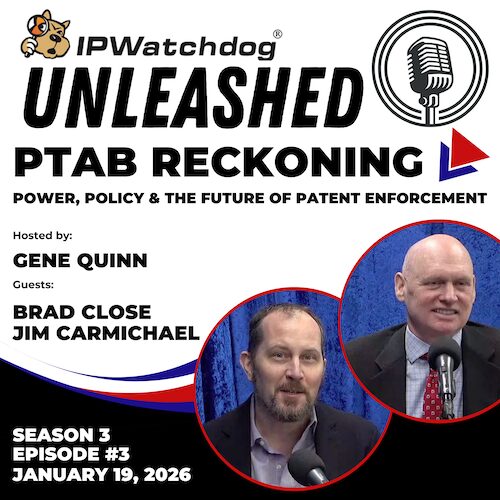
Why PTAB Reform Alone Won’t Save the U.S. Patent System | IPWatchdog Unleashed
In the latest episode of IPWatchdog Unleashed, I sat down with my good friends Brad Close, who is the Executive Vice President of Transpacific IP, and Jim Carmichael, a former judge on the Board of Patent Appeals and Interferences and founder of Carmichael IP. Brad, Jim and I engaged in a candid conversation that provides our unvarnished assessment of the Patent Trial and Appeal Board (PTAB), where it started historically, where it is today, and where it may finally be headed. Bottom line: the PTAB is no longer the automatic execution squad it once was, but durable patent rights will require reform well beyond the agency level.
Issa’s Latest Litigation Funding Bill Debated in House Judiciary Without Reaching Vote
The House Judiciary Committee on Tuesday considered the Protecting Third Party Litigation Funding (TPLF) From Abuse Act as part of a lengthy markup hearing that chiefly focused on escalating immigration enforcement operations in the United States. The bill did not reach a vote after committee members recessed for votes on the House floor and never reconvened. Sources tell IPWatchdog the bill has now been pulled.
Abuse of Discretion on Evidentiary Exclusions Leads CAFC to Vacate Parking Lot Management System Ruling
Today, the U.S. Court of Appeals for the Federal Circuit (CAFC) issued a ruling in Indect USA Corp. v. Park Assist, LLC largely affirming the Southern District of California in a patent infringement case involving methods of managing parking lots. However, the Federal Circuit reversed some aspects of the district court’s rulings after finding abuse of discretion by excluding evidence related either to invalidating sales of the patented method or to bad faith patent infringement allegations against several customers using the alleged infringer’s accused system, including a regional airport.
Federal Circuit Distinguishes Kyocera and Becton Dickinson in Upholding PTAB Obvious Finding for Electronic Patent
The U.S. Court of Appeals for the Federal Circuit (CAFC) on Wednesday upheld a Patent Trial and Appeal Board (PTAB) ruling that certain claims of Viasat Inc.’s data error correction patent are unpatentable as obvious. The opinion was authored by Judge Bryson. Western Digital Technologies, Inc. filed for inter partes review (IPR) of several claims of U.S. Patent No. 8,966,347 and the PTAB held all of the challenged claims unpatentable for obviousness. The Board ultimately found that any difference between Viasat’s claims and the key prior art reference (“Diggs”) “was a ‘semantic discrepanc[y]’ rather than a difference in substance.”
CAFC Upholds District Court Invalidation of Wireless Transmission Decoding Claims Under 101
The U.S. Court of Appeals for the Federal Circuit (CAFC) on Tuesday affirmed a district court decision finding that Technology in Ariscale, LLC’s patent for a transmission signal decoding method was ineligible under 35 U.S.C. § 101. The opinion was authored by Judge Cunningham.
Why Petrella and SCA Hygiene Protect Against Equitable Defenses of Prosecution Laches
The Supreme Court rejected equitable defenses of laches in infringement suits, reasoning that by enacting a statute of limitation, Congress left no statutory “gap” for equitable judgments on timeliness. See Petrella v. Metro-Goldwyn-Mayer (2014), and SCA Hygiene Prods. v. First Quality Baby Prods (2017). These precedential holdings should have also governed U.S. Court of Appeals for the Federal Circuit (CAFC) decisions on prosecution laches in Hyatt v. Hirshfeld (2021) and in Hyatt v. Stewart (2025), particularly after the multiple briefings in the Hyatt case on the binding effect of such holdings. Yet, nowhere in these decisions can one find any reasons why the principles in SCA Hygiene and Petrella should be inapplicable for precluding prosecution laches.
SEP Working Group to Continue USPTO’s Efforts Supporting Injunctive Relief for SEP Owners
On Monday, the U.S. Patent and Trademark Office (USPTO) announced that the agency has established a Standard-Essential Patent (SEP) Working Group to develop and deliver meaningful policy solutions on SEP-related issues. The working group, which will report to USPTO Director John Squires, will play a role in advancing the Office’s engagement with patent remedies and enforcement in furtherance of the pro-innovation stance the agency has taken on SEP cases before the U.S. International Trade Commission (USITC) and in U.S. district court.
CAFC Affirms Non-Infringement Finding in Dispute Over Silicone Container Patent
The U.S. Court of Appeals for the Federal Circuit (CAFC) on Tuesday affirmed a district court’s summary judgment of non-infringement in favor of SC Johnson & Son Incorporated in a case brought by Zip Top, Inc. The decision centered on the interpretation of a key term in a patent claim for reusable silicone containers. Zip Top appealed a decision from the United States District Court for the Northern District of Illinois that granted summary judgment of non-infringement to SC Johnson. Zip Top had asserted that SC Johnson’s Ziploc Endurables products infringed United States Patent No. 11,383,890, which discloses a process for making a container from molded silicone.
ITC 2025 Year in Review: A Momentous Shift, but the Impact Remains Pending
For Section 337 investigations before the U.S. International Trade Commission (ITC), 2025 was a year of contrasts. As one example, the Federal Circuit’s long-awaited decision in Lashify, Inc. v. ITC reduced the burden for satisfying Section 337’s domestic industry requirement, under which ITC complainants must show adequate U.S. investments in practicing or exploiting the asserted intellectual property rights. But this lower threshold did not immediately result in increased Section 337 complaint filings. For much of 2025, uncertainty concerning U.S. trade policy and federal government operations likely depressed ITC complaint filings.
CAFC Affirms PTAB Invalidation of MIT’s Fuel Management Patents in Dispute with Ford
On December 23, the U.S. Court of Appeals for the Federal Circuit (CAFC) issued a precedential decision in Ethanol Boosting Systems, LLC v. Ford Motor Company, affirming the Patent Trial and Appeal Board’s (PTAB) invalidation of three patents owned by the Massachusetts Institute of Technology (MIT) and licensed to Ethanol Boosting Systems (EBS). The opinion was authored by Judge Chen and joined by Judges Clevenger and Hughes.
Examining Developments and Trends at the Unified Patent Court in 2025
It’s been a year of significant decisions from the Unified Patent Court (UPC), from both the first instance Local Divisions (LDs) and Central Division (CD) and the Court of Appeal (CoA). Jurisdiction and, as more appellate decisions become available, the substantive law on patent validity and infringement, have come into focus. Decisions relating to enforcement also provide helpful indications for the future.
Are State ‘Anti-Troll’ Laws Constitutional? The Federal Circuit Avoids the Question (For Now)
On Thursday, the U.S. Court of Appeals for the Federal Circuit (CAFC) issued its opinion in Micron Technology v. Longhorn IP. As reported earlier, the CAFC held that it lacked jurisdiction to hear Longhorn’s appeal from a district court order that required Longhorn to post an $8 million bond to proceed with a patent infringement case. In imposing the bond, the district court had relied on Idaho’s “anti-troll” statute, which outlaws assertions of patent infringement made in “bad faith.” Also under that statute, if a court finds a “reasonable likelihood” that a patent owner has made a bad faith assertion, the court must require the patent owner to post a bond equal to its opponent’s estimated litigation costs and damages.
CAFC Dismisses EFF Appeal, Upholds Broad District Court Discretion on Motions for Permissive Intervention
Today, the U.S. Court of Appeals for the Federal Circuit issued a nonprecedential ruling in Entropic Communications, LLC v. Charter Communications, Inc. finding that the Eastern District of Texas did not abuse its discretion in denying third party Electronic Frontier Foundation’s (EFF) motion for permissive intervention in patent infringement proceedings. Applying Fifth Circuit rulings on Federal Rule of Civil Procedure (FRCP) 24(b), the Federal Circuit agreed that EFF did not timely move to unseal summary judgment briefs surrounding infringement under the relevant cable data transmission standard.
Varsity Sponsors
![[Advertisement]](https://ipwatchdog.com/wp-content/uploads/2026/02/Junior-AI-Feb-10-2026-sidebar-CLE-700x500-1.jpg)
![[Advertisement]](https://ipwatchdog.com/wp-content/uploads/2026/02/Anaqua-Feb-12-2026-sidebar-700x500-1.jpg)
![[Advertisement]](https://ipwatchdog.com/wp-content/uploads/2025/12/LIVE-2026-sidebar-regular-price-700x500-1.jpg)

Latest IPW Posts
Netflix Scores Win at CAFC in Reversal of 101 Decision for Patent Owner
February 9, 2026 @ 04:36 pmFederal Circuit Finds In-Store Product Locator Patents Ineligible as Abstract
February 9, 2026 @ 09:15 amHow Temu Works With Brands to Protect Intellectual Property Rights
February 9, 2026 @ 08:15 amPatent Portfolio Economics: Balancing Quality, Cost and Market Coverage
February 8, 2026 @ 01:00 pm
Latest Podcasts


IPWatchdog Events
CLE Webinar: How to Prompt AI – A Hands-On Workshop for Patent Prep and Pros
February 10 @ 12:00 pm - 1:00 pm ESTWebinar: IP at Risk – Avoiding Costly Compliance Mistakes in Export Controls
February 12 @ 12:00 pm - 1:00 pm ESTWebinar: Optimizing the Chemistry Drafting Process – Where AI Actually Helps
February 17 @ 12:00 pm - 1:00 pm ESTWebinar: Resurrecting Antibody Genus Protection – Allowed Claims Through CDR-Scanning
March 5 @ 12:00 pm - 1:00 pm ESTIPWatchdog LIVE 2026 at the Renaissance Arlington Capital View
March 22 @ 1:00 pm - March 24 @ 7:00 pm EDT
Industry Events
From IPWatchdog
![[Advertisement]](https://ipwatchdog.com/wp-content/uploads/2021/12/WEBINAR-336-x-280-px.png)
![[Advertisement]](https://ipwatchdog.com/wp-content/uploads/2021/12/Ad-4-The-Invent-Patent-System™.png)