
![[IPWatchdog Logo]](https://ipwatchdog.com/wp-content/themes/IPWatchdog%20-%202023/assets/images/temp/logo-small@2x.png)
Posts Tagged: "Patent Trolls"
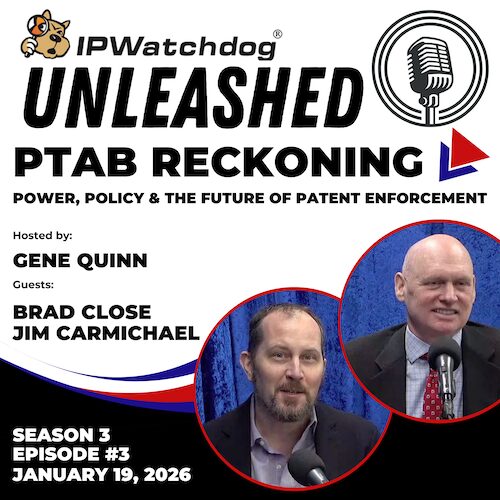
Why PTAB Reform Alone Won’t Save the U.S. Patent System | IPWatchdog Unleashed
In the latest episode of IPWatchdog Unleashed, I sat down with my good friends Brad Close, who is the Executive Vice President of Transpacific IP, and Jim Carmichael, a former judge on the Board of Patent Appeals and Interferences and founder of Carmichael IP. Brad, Jim and I engaged in a candid conversation that provides our unvarnished assessment of the Patent Trial and Appeal Board (PTAB), where it started historically, where it is today, and where it may finally be headed. Bottom line: the PTAB is no longer the automatic execution squad it once was, but durable patent rights will require reform well beyond the agency level.
CAFC Affirms Non-Infringement Finding for Shopify, Scrapping $40 Million Jury Verdict
The U.S. Court of Appeals for the Federal Circuit (CAFC) on Monday affirmed a district court’s summary judgment of non-infringement and judgment as a matter of law (JMOL) in Shopify Inc. v. Express Mobile, Inc., confirming the rejection of a $40 million jury verdict against Shopify. Shopify filed a declaratory judgment action in the U.S. District Court for the District of Delaware, seeking a declaration of noninfringement of the claims of U.S. Patent Nos. 9,063,755, 9,471,287, 6,546,397, and 7,594,168, which relate to website design and functionality. Express Mobile counterclaimed for infringement of those patents and additionally asserted U.S. Patent No. 9,928,044 by accusing Shopify’s Theme Editor and its underlying “Liquid” template technology.
Testing the Limits of State ‘Anti-Troll’ Laws
The U.S. Court of Appeals for the Federal Circuit on Monday heard oral argument in Micron Technology v. Longhorn IP, a test of state “anti-troll” statutes’ interplay with federal patent law. As inter partes review (IPR) becomes more and more difficult to obtain, those state statutes could play an important role in discouraging abusive patent enforcement—provided they are deemed to be constitutional.
Gaming Patent Litigation on Both Sides of the ‘v’ | IPWatchdog Unleashed
This week on IPWatchdog Unleashed, we enter the patent litigation world for a conversation about gaming patent litigation. For too long, popular sentiment has been that patent owners are bad actors simply because they are patent owners. A more nuanced but still grossly overbroad view is that patent owners are not per se bad actors, but if you are a patent owner who has the audacity to enforce a patent against an alleged infringer then you are most definitely a bad actor. Obviously, just being a patent owner does not make one a bad actor, and neither does enforcing a patent against an alleged infringer. But this patent troll narrative has been quite successful
Forget the Trolls, It’s Time to Embrace the Elves
The term “patent troll” has become ubiquitous in the IP world since it was first coined at Intel in the late 1990s. There is no single definition of what it means but it is always used pejoratively and is most frequently deployed against non-practicing entities (NPEs). NPEs do not manufacture patented products. Instead, they derive economic value from IP sales, licensing or other monetization activities. In recent years, there has been a deliberate and partially successful effort to conflate NPEs with patent trolls. However, to do this is disingenuous at best, dishonest at worst.
What Went Wrong and How to Fix the Patent System
My conversation this week with John White was much like any number of conversations we have had over the years over dinner or drinks. What prompted me to ask John to speak with us this week was an article he recently wrote, which we published on IPWatchdog. It was styled as an open letter to Elon Musk and Vivek Ramaswamy, the incoming co-leaders of the soon-to-be Department of Government Efficiency. In that article John explains that “the patent system is currently foundered”, but that it can be fixed with “focus and ongoing commitment to see the fixes through to results.” So, that is where we start our conversation, like so many we have had over the last 26 years—what is wrong with the patent system and how should it be fixed.
Perspectives on Patent Trolls and Efficient Infringement | IPWatchdog Unleashed
There is absolutely no doubt that at least some bad-acting patent owners continue to engage in a systematic game of extortion that leverages judicial inefficiencies and the often-outrageous costs of fighting and winning even when there is absolutely no merit to the patent infringement allegations. And these patent owners who do engage in this type of bad action do the industry a tremendous disservice, because these nefarious actors behave so egregiously that it causes a stain on the entire industry, and sadly it allows for all patent owners to be swept up together. That means that those patent owners with a real grievance—and there are many—get unfairly labeled as patent trolls and treated as if they are engaging in the same low-rent bad action as the truly nefarious actors.
New Data Show There Is a Problem with the U.S. Patent System—But It’s Not Patent Trolls
If the headlines are to be believed, every aspect of American life, from farming to football, is under threat due to excessive patent litigation. While these anecdotes may seem compelling, it is important to look at the underlying data before drawing any conclusions about the state of the U.S. patent system. As an economist and one of the authors of the Federal Trade Commission’s study of patent assertion entities (PAEs), I understand the value data can bring to patent policy debates, and have also seen firsthand the damage evidence-free policymaking has on America’s innovation ecosystem.
High-Tech Groups and EFF Revive Patent Troll Narrative and Other Lies
Efforts by high-tech companies to undermine both the Patent Eligibility Restoration Act of 2023 and the Promoting and Respecting Economically Vital American Innovation Leadership (PREVAIL) Act ramped up this week, with a joint letter sent to the Senate Judiciary Committee by a number of tech industry organizations on Monday and a campaign launched by the Electronic Frontier Foundation (EFF) yesterday.
Finding the Trolls: My Mission to Understand Why We Need the PTAB
I was told that elected officials count on—in fact, they need—constituent input to be effective legislators. After my patents were unjustly cancelled at the Patent Trial and Appeal Board (PTAB), I started the journey to do this very thing. Since January of 2022, I have visited Congress and the Senate two dozen times. I have visited over 200 offices telling my story and advocating for the “little” inventors, like me.
Big Tech’s Great Patent Troll Smash and Grab
Big Tech’s patent troll narrative is really just the great Big Tech smash and grab. Jean Ann Booth explains in the Waco Tribune what patent trolls are by taking Big Tech’s cartoonish characterization as her own: Patent trolls are rich investors who buy up patents from failed startups just so they can sue companies commercializing the invention in order to extort their money. Extortion – that’s what patent trolls do. And they are wrecking U.S. innovation to boot. They sure sound scary. Patent trolls are indeed frightening. Flush with big bucks, Big Tech lobbyists pushed the patent troll narrative on Congress, the administration, and the courts, demanding that we gut U.S. patent law (the same U.S. patent law that drove over 200 years of American innovation) if we are to save American innovation. Government bureaucrats and politicians complied by smashing the U.S patent system. Now Big Tech can grab whatever technology they want.
Becoming Harder to Justify a One-Size-Fits-All Patent System
Meanwhile, all patents— good, bad, revolutionary, and stupid— have eroded to the point where continued use of the U.S. patent system must be questioned. Despite the statute saying that patents are to be treated as property rights, the Supreme Court has ruled that patents are merely government franchises that can be stripped at any point in time during the life of the patent regardless of how much time or money has been invested by the patent owner. It simply cannot make any sense for all patents to become increasingly worthless simply because of the victimization of large multinational corporations who are incapable of crafting a strategy that solves the nuisance litigation problem that does not destroy the entire system.
Government Must Reform the ITC to Keep Pace with Innovation and Curb Trolls
In 2001, six years before the iPhone appeared, a futurist named Ray Kurzweil wrote that humankind would cram 20,000 years of technological progress into the century that had just begun. There were skeptics, but today any of the world’s six billion smartphone subscribers can read his essay on their devices practically any time, any place they choose. As we move into an era of Artificial Intelligence (AI), quantum computing, and 5G telecommunications that supports Kurzweil’s vision, we must make sure that our laws and federal agencies match the pace of invention and protect innovators from trolls who would game the legal system and government functions for their ill-gained profit.
A Closer, Evidence-Based Look at ‘Patent Quality’ Advocacy
The Patent Infringer Lobby has ramped up banging the drum about “patent quality.” They dedicated a week-long campaign to questioning “patent quality,” which its constituents regard as a huge problem. Advocates have taken advantage of the vacuum left after U.S. Patent and Trademark Office (USPTO) Director Andrei Iancu left the building. Anti-patent advocates are exploiting the new dynamic of Senator Patrick Leahy, coauthor of the America Invents Act (AIA), who now chairs the Senate Intellectual Property Subcommittee. Leahy recently did the Infringer Lobby the favor of holding a hearing on this subject.
How One ITC Initial Determination Highlights the Links Among a Strong Patent System, Jobs and International Cooperation
An Administrative Law Judge (ALJ) at the International Trade Commission (ITC) recently determined that Samsung Phones violate key patents on magnetic emulator technology for contactless payment systems from Pittsburgh’s Dynamics, Inc. We have been collaborating for years in the academic and public sectors on issues raised in that case, and are consulting consult with Dynamics because we think these issues are vital to our innovation ecosystem, our national economy, and our commitments to international partners. It is especially illustrative of the serious risks facing these vital public interests that far too frequently when there has been a full and fair adjudication determining that there has been infringement of multiple patents and that those patents are neither invalid nor unenforceable, the headline more than suggests that the infringer has been cleared of responsibility.
Varsity Sponsors
![[Advertisement]](https://ipwatchdog.com/wp-content/uploads/2026/02/Junior-AI-Feb-10-2026-sidebar-CLE-700x500-1.jpg)
![[Advertisement]](https://ipwatchdog.com/wp-content/uploads/2026/02/Anaqua-Feb-12-2026-sidebar-700x500-1.jpg)
![[Advertisement]](https://ipwatchdog.com/wp-content/uploads/2025/12/LIVE-2026-sidebar-regular-price-700x500-1.jpg)

Latest IPW Posts
CAFC Agrees Content Sharing Patents are Ineligible in Win for Walmart
February 5, 2026 @ 01:32 pmFederal Circuit Affirms Noninfringement Finding in Ladder Patent Dispute
February 5, 2026 @ 12:15 pmCAFC Affirms Summary Judgment Ruling in Patent Suit Against NASA Mars Helicopter Subcontractor
February 4, 2026 @ 03:15 pmJudge Wolson Issues Key Summary Judgment Ruling on Eve of Trial in Arbutus v. Moderna
February 4, 2026 @ 01:15 pm
Latest Podcasts


IPWatchdog Events
CLE Webinar: How to Prompt AI – A Hands-On Workshop for Patent Prep and Pros
February 10 @ 12:00 pm - 1:00 pm ESTWebinar: IP at Risk – Avoiding Costly Compliance Mistakes in Export Controls
February 12 @ 12:00 pm - 1:00 pm ESTWebinar: Optimizing the Chemistry Drafting Process – Where AI Actually Helps
February 17 @ 12:00 pm - 1:00 pm ESTWebinar: Resurrecting Antibody Genus Protection – Allowed Claims Through CDR-Scanning
March 5 @ 12:00 pm - 1:00 pm ESTIPWatchdog LIVE 2026 at the Renaissance Arlington Capital View
March 22 @ 1:00 pm - March 24 @ 7:00 pm EDT
Industry Events
From IPWatchdog
![[Advertisement]](https://ipwatchdog.com/wp-content/uploads/2021/12/WEBINAR-336-x-280-px.png)
![[Advertisement]](https://ipwatchdog.com/wp-content/uploads/2021/12/Ad-4-The-Invent-Patent-System™.png)