
![[IPWatchdog Logo]](https://ipwatchdog.com/wp-content/themes/IPWatchdog%20-%202023/assets/images/temp/logo-small@2x.png)
All Posts
The AI Ethics Waterfall: Disclosure, Governance, and Who’s Really Responsible
From a trickle just a few years ago, AI use in the patent profession has become a rushing torrent. AI tools, features, and applications are now an integral and sometimes invisible part of patent practice. From invention harvesting and prior art searching to drafting, filing, opinion work, litigation, and licensing, the savvy patent practitioner almost certainly has AI embedded somewhere in their workflow.
CAFC Affirms JMOL of Non-Infringement in Blood Sequestration Device Patent Dispute
The U.S. Court of Appeals for the Federal Circuit (CAFC) today issued a precedential decision in Magnolia Medical Technologies, Inc. v. Kurin, Inc., affirming a district court’s judgment as a matter of law of no infringement. The court determined that the plain and ordinary meaning of a claim with separately listed limitations requires separate corresponding structures, and because the accused product utilized a single structure for both limitations, it did not infringe as a matter of law.
Rose Esfandiari
March 8, 2026
 0
0
Squires Orders Appeals Panel to Review PTAB Rehearing Decision Reversing ODP Rejections
The U.S. Patent and Trademark Office (USPTO) announced Thursday that it will convene an Appeals Review Panel (ARP) to examine the issues raised by a 2025 rehearing decision of the Patent Trial and Appeal Board (PTAB) with respect to obviousness-type double patenting (ODP). In Ex Parte Baurin, issued on December 18, 2025, the PTAB denied an examiner’s request for reconsideration of the Board’s November 8, 2024, decision reversing the examiner’s ODP rejections of several claims of US Application No. 17/135,529, directed to antibody-like binding proteins. The Board found that the reference patent the examiner relied upon for its ODP analysis, U.S. Patent No. 10,882,922, was not a proper ODP reference because it was later filed and later expiring than the application in the present case.
Eileen McDermott
March 6, 2026
0
Other Barks & Bites for Friday, March 6: WIPO Issues PCT Filing Study; CAFC Affirms Use of Unaccused Devices in Royalty Determination; USTR Notorious Markets List Highlights Live Sports Piracy
This week in Other Barks & Bites: the World Intellectual Property Organization releases a study showing a slight uptick in international patent filings for the second straight year; Moderna stock rises nearly 10% on news of its patent infringement settlement over COVID-19 vaccine technology; the Federal Circuit says there is no per se rule against consideration of noninfringing features in a reasonable royalty determination; and more.
Steve Brachmann
March 6, 2026
0
USTR Report May Stem Trade Partners’ Weak-Patent Agenda
China, the EU and the UK are quietly rewriting the rules on standard-essential patents (SEPs) in ways that strip value from U.S. innovators’ technology. As the Office of the U.S. Trade Representative (USTR) finalizes its 2026 Special 301 Report, Washington has a rare chance to call out these trading partners for turning global licensing into a government-managed exercise that drives royalty rates below market value.
James Edwards
March 5, 2026
2
When Policy Narratives Override the Facts: A Response to Recent Commentary on My PTAB Case
In a recent Substack post discussing Patent Trial and Appeal Board (PTAB) policy and current U.S. Patent and Trademark Office (USPTO) reforms, former USPTO Deputy Solicitor Thomas Krause referenced my PTAB case as part of his broader argument. Because my case was cited in that discussion, the factual record matters… My case does not support the claim that the PTAB primarily exists to correct examiner errors or clean up patents issued over missed prior art.
Molly Metz
March 5, 2026
9
A Rose by Any Other Name? The Perils of Personal Names as Brand Names
For founders, naming a brand after oneself can feel like the most natural—and powerful—choice. A personal name signifies authenticity, craftsmanship, and accountability. Consumers feel they are not just buying a product, but a person’s vision, values, and reputation. In the apparel, beauty, and skincare space in particular, a founder’s identity often is the brand. That alignment can drive early momentum and deep consumer loyalty. But the same naming strategy that builds value at launch can create significant legal and business complications at scale—especially at exit.
Elizabeth (Liz) Sbardellati
March 5, 2026
0
Moderna Settles with Genevant and Arbutus, Ending LNP Patent Dispute
In a press release issued on Tuesday, Genevant Sciences and Arbutus Biopharma announced they have entered into a global settlement with Moderna, Inc. that could result in a payment of up to $2.5 billion. The announcement stated that the settlement resolves all U.S. and international patent litigation concerning the unauthorized use of Genevant’s and Arbutus’ lipid nanoparticle (LNP) delivery technology in Moderna’s COVID-19 vaccines. The agreement came just days before a highly anticipated jury trial was scheduled to begin in the U.S. District Court for the District of Delaware.
Rose Esfandiari
March 4, 2026
0
Opinion: Keep Going Squires USPTO: Inventors Want a Streamlined Claim Set Pilot Program 2.0
Under today’s patent system, inventors are only allowed to procure one type of patent—the standard utility patent. Despite the amount of power in the standard utility patent, this restriction oppresses the American inventor. Large numbers of people cannot afford the costs to procure and enforce the standard utility patent, and for many of the ones who can, it often does not pack enough firepower to allow them to fully recover. Because each invention is different, each instance of infringement is different. A single $20,000-$30,000 utility patent is not even close to being capable of addressing every one of those instances. The solution is very simple—different types of patents must be created.
John Powers
March 4, 2026
1
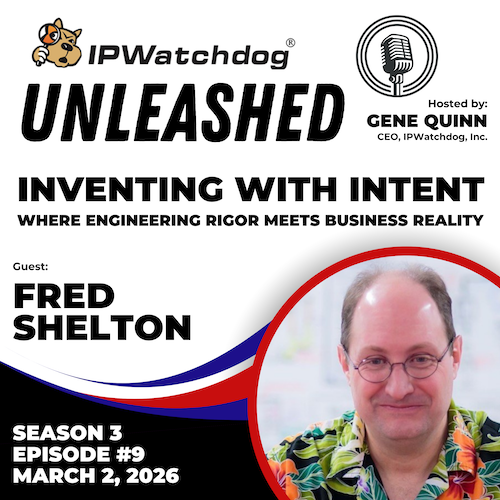
Inventing with Intent: Where Engineering Rigor Meets Business Reality | IPWatchdog Unleashed
What does it mean to be a prolific inventor in an era of corporate retrenchment, weakened patent rights, and risk-averse innovation culture? This week on IPWatchdog Unleashed, I had the opportunity to explore that question with Fred Shelton—an engineer who has accumulated more than 3,000 patents over roughly two decades, primarily during his career at Johnson & Johnson. Shelton describes himself not as an IP professional, but as an engineer who “documents engineering through patents.” That distinction is more than semantic. It reflects a philosophy of invention that is structured, disciplined, and deeply contextual.
Gene Quinn
March 3, 2026
2
CAFC Partially Reverses PTAB Decision Upholding Patient Imaging Patent Claims
The U.S. Court of Appeals for the Federal Circuit (CAFC) on Tuesday partially reversed and remanded a decision of the Patent Trial and Appeal Board (PTAB) that had found Medivis, Inc. failed to show certain claims of Novarad Corp.’s patient imaging patent unpatentable as anticipated and also failed to show other claims unpatentable as obvious. The CAFC affirmed as to anticipation but reversed as to obviousness, holding that the Board relied on the wrong legal standard in finding no motivation to combine.
Eileen McDermott
March 3, 2026
0
When Lawyers Need Help: Supporting Colleagues While Protecting Clients
The legal profession rewards endurance, precision and control. It also quietly normalizes stress, isolation and overextension. For patent practitioners and other IP lawyers, the pressures are uniquely acute: compressed prosecution deadlines, high-stakes litigation exposure, often unrealistic client-driven budget constraints, regulatory whiplash at the U.S. Patent and Trademark Office (USPTO), and increasingly complex technologies layered with global filing and prosecution strategy. The result is predictable. Even the most capable lawyers will, at some point in their careers, struggle.
Cool AI Patents of the Month: Real-Time Sports Insights and Smarter Vehicles
Welcome back to Cool AI Patents of the Month, where we spotlight inventive developments at the intersection of artificial intelligence (AI) and intellectual property. In this installment, we take a look at two standout innovations—one that could transform how we watch sports, and another that may reshape how our vehicles understand the road ahead. Both illustrate how quickly AI is integrating itself into our daily lives.
John M. Rogitz
March 3, 2026
0
Supreme Court Denies Thaler’s Latest Attempt to Register Copyright to AI-Generated Image
Today, the U.S. Supreme Court issued an order list including the denial of a petition for writ of certiorari filed by Dr. Stephen Thaler that challenged federal agency and court rulings preventing copyright registration for an image generated entirely by artificial intelligence (AI). In following the U.S. Solicitor General’s call to deny cert to Thaler’s appeal, the Supreme Court declined invitations from both sides of the AI authorship debate to clarify the copyrightability of works that are substantially AI-generated.
Steve Brachmann
March 2, 2026
3
Squires Updates Conflict of Interest Guidance for Examiners Following DOJ Settlement Announcement
Following a Department of Justice (DOJ) press release issued last week announcing that a patent examiner agreed to pay $500,000 to settle allegations that she worked on a number of patent applications in which she held a direct financial stake, U.S. Patent and Trademark Office (USPTO) Director John Squires on Monday issued new guidance directing patent examiners to recuse themselves in all instances where they have a financial stake in a patent applicant’s company.
Eileen McDermott
March 2, 2026
0

Latest Podcasts


IPWatchdog Events
IPWatchdog LIVE 2026 at the Renaissance Arlington Capital View
March 22 @ 1:00 pm - March 24 @ 7:00 pm EDT